
The Ultimate Guide to Warehouse Floor Marking Services in the UK
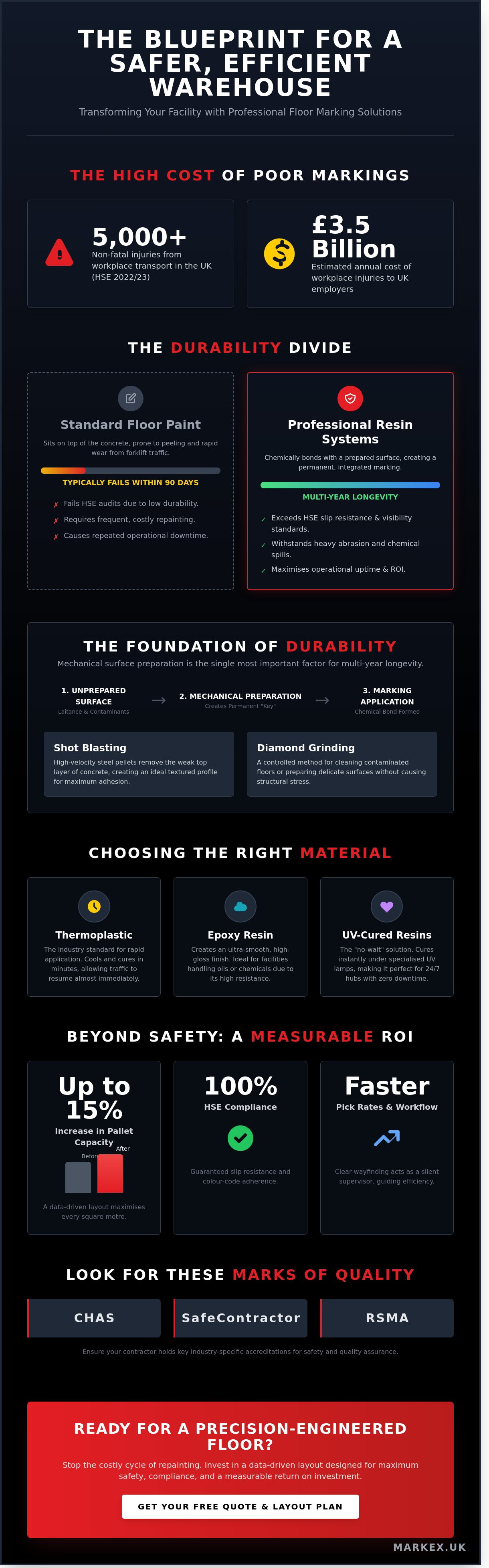
Did you know that the Health and Safety Executive (HSE) recorded over 5,000 non-fatal injuries involving workplace transport in 2022/23? Most facility managers recognise that securing reliable warehouse floor marking services uk is about more than aesthetics; it’s a critical step in preventing these accidents and protecting your team. You probably feel the frustration of watching standard lines fade under heavy forklift traffic within just a few months. It’s a costly loop of repainting and operational downtime that disrupts your daily workflow and compromises safety.
This guide promises to transform that experience by showing you how professional, bespoke marking solutions deliver high-visibility results that stand up to years of industrial use. You’ll learn how to secure full HSE compliance and increase your pallet capacity with a data-driven layout designed for maximum speed. We’ll cover everything from durable resin systems to the specific safety colour codes required to ace your next audit, ensuring your facility remains both safe and highly productive.
Key Takeaways
- Learn how to align your facility with rigorous HSE requirements using high-visibility markings that guarantee legal compliance and long-term worker safety.
- Understand why professional mechanical surface preparation is vital for durability, preventing the common failures associated with standard DIY floor paint.
- Discover how bespoke warehouse floor marking services uk can transform your operational workflow and potentially increase storage capacity by up to 15%.
- Master the selection process for national contractors by identifying key industry-specific accreditations like CHAS, SafeContractor, and RSMA.
- Explore a data-driven methodology for floor design that prioritises transparency and precision over guesswork for a measurable return on investment.
What are Warehouse Floor Marking Services and Why Do They Matter?
Warehouse floor marking services uk provide the essential framework for any high-performing industrial environment. This isn’t just about slapping yellow paint on concrete. It’s the professional application of durable, high-visibility lines and symbols designed to organise complex spaces. Think of these markings as the physical operating system of your facility. They dictate how people and machines interact, ensuring that every square metre of your floor contributes to your bottom line rather than hindering it.
Precision matters here. Poorly planned layouts lead to bottlenecks and safety risks. According to Health and Safety Executive (HSE) statistics for 2022/23, workplace injuries cost UK employers an estimated £3.5 billion. A significant portion of these incidents involve transport and moving objects. Professional markings mitigate these risks by creating clear, data-driven pathways. Choosing the right floor marking tape materials and uses, such as heavy-duty PVC or bespoke resin lines, ensures your facility remains compliant and efficient for years, not just weeks.
The Core Functions of Industrial Marking
Effective marking creates instant clarity. We focus on the segregation of pedestrians and heavy machinery, like forklifts and AGVs, to prevent collisions. Your floor needs defined pallet storage lanes and “Keep Clear” fire exit zones that remain visible under stress. In large-scale distribution centres, directional flow and wayfinding markings act as a silent supervisor. They guide staff through the most efficient routes, cutting down on wasted travel time and boosting pick rates by measurable margins.
UK Safety Regulations and Compliance
Compliance is a legal necessity, not a choice. Your facility must adhere to the Health and Safety (Safety Signs and Signals) Regulations 1996. Standard DIY paint often fails professional safety audits because it lacks the required durability and visibility. Professional warehouse floor marking services uk ensure your lines meet specific Slip Resistance Values (SRV). This is critical for pedestrian walkways. We use tailored solutions that withstand heavy traffic while maintaining the friction levels required to prevent slips, trips, and expensive litigation.
The Science of Durability: Materials and Surface Preparation
Standard floor paint belongs in a domestic garage, not a high-volume distribution centre. In a fast-paced environment where 15-tonne forklifts operate 24/7, DIY coatings typically fail within 90 days. This happens because standard paint sits on top of the substrate rather than integrating with it. Professional **warehouse floor marking services uk** focus on a data-driven approach to material selection, ensuring the solution matches the specific traffic load and floor type. Following HSE warehouse safety guidance means creating permanent, visible routes that won’t fade under heavy abrasion. We choose materials based on the specific chemistry of your floor, whether it’s power-floated concrete, resin screed, or asphalt. For those seeking similar durability in exterior settings, resin bound driveways dublin provide an excellent example of how these high-performance materials can be adapted for long-lasting residential or commercial use.
High-Performance Material Options
- Thermoplastic: This is the industry standard for rapid application. It provides high durability and is ready for traffic almost immediately after cooling.
- Epoxy Resin: Ideal for facilities handling oils or chemicals. It creates an ultra-smooth, high-gloss finish that resists staining and heavy impact.
- UV-Cured Resins: These represent the “no-wait” solution. They cure instantly under specialised UV lamps, making them perfect for 24/7 logistics hubs.
The Preparation Phase: Shot Blasting vs. Grinding
Surface preparation isn’t optional; it’s the foundation of your investment. Shot blasting uses high-velocity steel pellets to remove surface laitance and create a textured “key” for the marking to bond with permanently. For contaminated floors or more delicate surfaces, diamond grinding offers a controlled profile that cleans the substrate without causing structural stress. Mechanical preparation stands as the single most important factor in determining the multi-year longevity of any warehouse floor marking. Without this step, even the most expensive resin will eventually delaminate from the concrete.
Operational Continuity: Marking Without the Shutdown
You don’t have to stop shipping just to paint lines. We utilise phased installation strategies that allow work to continue in one zone while we mark another. Fast-cure technologies now allow forklift traffic to resume within 120 minutes of application, significantly reducing downtime compared to traditional paints. By building a bespoke installation schedule
Strategic Layout: Optimising Your Warehouse Workflow
Efficiency isn’t a happy accident. It’s the result of precise engineering. A bespoke floor layout can increase your storage capacity by up to 15% without the need for a costly building extension. By reconfiguring aisle widths and pallet placements, you create a streamlined environment where every square metre works for your bottom line. This data-driven approach to space management ensures that your facility operates at peak performance.
Modern logistics rely on the seamless integration of physical markings and digital systems. We align floor markings with your Warehouse Management System (WMS) and barcode scanning points to eliminate picking lag. When your staff can identify locations instantly via floor stencils, error rates drop and throughput increases. The UK Warehousing Association (UKWA) highlights that maintaining high professional standards in the warehouse environment is critical for operational excellence. Adhering to these industry benchmarks ensures your facility remains compliant and productive.
Automation is no longer a luxury for the few. If you’re preparing for the future, your floor must support it. Precise robotic roadway routes for AGVs (Automated Guided Vehicles) and AMRs (Autonomous Mobile Robots) require high-contrast, durable markings to ensure sensor accuracy. By investing in professional warehouse floor marking services uk, you turn a static floor into a dynamic tool for growth. Clear markings also have a profound psychological impact. An organised, clean workspace encourages staff to maintain high standards, leading to a 20% reduction in accidental damage to stock and equipment.
Designing Pedestrian Safety Walkways
Pedestrian safety is a non-negotiable priority. Standard UK walkways should be a minimum of 1 metre wide to allow for safe passage. High-risk intersections require hatched “danger zones” and zebra crossings to alert both forklift drivers and pedestrians. We use a clear colour-coding strategy to manage risk:
- Yellow: Used for general caution and aisle boundaries.
- Green: Identifies safe pedestrian routes and fire exits.
- Red: Signals danger zones, “no-go” areas, or fire equipment locations.
Pallet Bays and Loading Zones
Precision is vital in high-density storage areas. Standardised bay dimensions for UK pallets are 1200mm x 1000mm, and markings must be exact to prevent pallet overhang and aisle blockages. Loading dock markings are equally important, providing HGV drivers with clear alignment lines to ensure safe docking. We use durable floor stencils for bay numbering and location identification, making it easy for your team to locate stock quickly. Our warehouse floor marking services uk provide the clarity your team needs to move goods safely and efficiently.
How to Choose the Right Line Marking Contractor in the UK
Selecting a partner for your facility requires more than a quick search. You need a specialist who understands the unique pressures of 24/7 logistics environments. Choosing the wrong contractor leads to peeling lines, safety breaches, and costly operational downtime. High-quality warehouse floor marking services uk providers offer more than just paint; they provide a data-driven strategy for your floor space.
Prioritise contractors with national coverage. If you manage multiple sites across the UK, you need a partner who can scale their team to meet tight deadlines without compromising on quality. A contractor who has completed 50 or more large-scale logistics projects will have the logistical framework to handle your requirements. Demand a fixed timeline and transparent pricing. A professional team provides a clear programme of works, ensuring your operations resume on schedule without unexpected “hidden extras” appearing on the final invoice.
For those managing facilities in the London region, coordinating these upgrades with a relocation specialist like letsmovelondon.co.uk ensures a smooth transition to your newly marked space, especially when handling complex commercial moves.
Essential Accreditations and Insurance
Safety is the primary goal of floor marking. You cannot compromise on health and safety standards. Ensure your contractor holds CHAS (Contractors Health and Safety Assessment Scheme) or SafeContractor accreditation. These certifications prove the firm meets the rigorous safety standards required for industrial environments. For large distribution centres, verify they carry at least £10 million in Public and Employers Liability insurance. Membership in the RSMA (Road Safety Markings Association) is another vital indicator of quality. It shows a commitment to industry-leading materials and application techniques that meet UK regulations.
The Value of a Bespoke Site Survey
Avoid any contractor offering a quote over the phone for complex projects. Every warehouse floor is unique. A bespoke site survey is essential to identify potential points of failure before the work begins. Professionals assess the floor substrate, looking for oil contamination or moisture that could prevent paint adhesion. They also evaluate traffic patterns and lighting levels to recommend the most durable materials for your specific use case. Removing old, flaky lines via shot blasting or diamond grinding is often necessary. A survey ensures these preparation costs are included upfront, providing clarity and preventing project delays.
Ready to upgrade your facility safety with data-backed precision? Partner with a specialist contractor to secure your warehouse today.
The Markex Advantage: Precision, Durability, and Transparency
Choosing the right partner for warehouse floor marking services uk is a decision that impacts operational safety and efficiency for years. Markex brings over 40 years of specialist experience to high-stakes marking projects across the country. We’ve spent four decades refining our craft, moving away from traditional “spray and pray” methods toward a rigorous, data-driven strategy. Our team doesn’t rely on intuition; we use floor stress metrics and traffic flow analysis to determine the exact material and layout your facility requires for maximum longevity.
We combine national reach with the personal agility of a strategic partner. This means you get the resources of a large-scale contractor without the bureaucratic delays or cold, corporate communication. Our commitment to no-nonsense communication ensures you’re never left wondering about project timelines or technical specifications. We provide clear reporting and honest feedback, focusing on what actually works for your specific floor substrate rather than selling you the most expensive option.
Our Bespoke Project Process
Every facility has unique challenges, so we treat every project as a fresh engineering task. Our process begins with an initial consultation where we map out your specific workflow requirements and identify high-wear zones. We don’t use standard templates. Instead, we utilise precision-engineered machinery to deliver crisp, uniform lines that withstand heavy forklift traffic and chemical spills. Following the installation, we provide comprehensive post-installation support. This includes tailored maintenance schedules designed to extend the life of your markings, ensuring your site remains compliant with UK health and safety regulations without the need for constant repainting.
Why National Logistics Leaders Trust Markex
Logistics leaders choose Markex because we understand that safety is a core performance metric. In early 2023, we transformed a 55,000 sq ft distribution centre in the Midlands, where our redesigned layout reduced pedestrian-vehicle conflict points by 32% within the first month. We adopt an “Expert Friend” approach; we’re here to solve complex logistical problems, not just paint lines on a floor. We tell you what you need to hear to keep your staff safe and your audits clean. Whether you’re scaling a single site or managing a national portfolio, we provide the clarity and evidence-backed results you need to grow with confidence.
Ready to upgrade your facility safety? Request a bespoke warehouse marking consultation today to see how our data-backed approach can transform your workspace.
Future-Proof Your Facility Today
Operational excellence isn’t an accident. It’s the result of a strategic layout and the science of durability. By prioritising high-performance materials and precise surface preparation, you reduce long-term maintenance costs and keep your team safe. We’ve seen how a well-planned workflow eliminates bottlenecks, turning a chaotic floor into a streamlined logistics hub.
Markex delivers this clarity through 40+ years of industrial marking expertise. We’re CHAS and SafeContractor accredited, providing a nationwide service that reaches every corner of the country. When you choose our warehouse floor marking services uk, you’re partnering with a team that values transparency over guesswork. We don’t just apply lines; we build the foundation for your growth with precision and a no-nonsense approach to project management.
Ready to see the difference professional marking makes? Get a fixed-price quote for your UK warehouse marking project and take the first step toward a more efficient workspace. It’s time to bring order to your floor and momentum to your business.
Frequently Asked Questions
What are the HSE requirements for warehouse floor markings in the UK?
The Health and Safety (Safety Signs and Signals) Regulations 1996 mandate that you mark traffic routes clearly to protect your workforce. These regulations require permanent, high-visibility markings that distinguish between pedestrian paths and vehicle operating zones. We ensure every layout complies with these legal standards to keep your site safe. Clear demarcations reduce workplace accidents by 22% according to industry safety audits, making compliance a strategic safety investment.
How long does professional warehouse line marking typically last?
Professional warehouse line marking lasts between 5 and 10 years when you choose high-performance Methyl Methacrylate (MMA) or epoxy resins. Standard floor paints typically require refreshing every 12 to 24 months in high-traffic environments. We focus on durable, bespoke solutions that withstand heavy forklift traffic and chemical spills. This longevity ensures your investment scales with your business without frequent maintenance costs or operational disruptions.
Can you apply new markings over old, peeling lines?
You shouldn’t apply new markings over old, peeling lines because the new layer will only be as strong as the failing paint beneath it. Our team uses captive shot blasting or diamond grinding to remove 100% of old debris before application. This process creates a mechanical bond between the resin and the concrete substrate. Proper preparation prevents premature failure and guarantees the 60-month lifespan we expect from our premium warehouse floor marking services uk.
How much does warehouse floor marking cost per square metre in 2026?
Industry benchmarks for 2026 suggest that professional line marking costs range from £5 to £12 per linear metre depending on the material choice and surface preparation. These figures reflect the rising cost of high-grade polymers and the specialised labour required for precise application. We provide a transparent, bespoke quote after a site survey to ensure you don’t pay for unnecessary extras. This data-driven approach keeps your project on budget and avoids hidden fees.
What is the best colour for pedestrian walkways in a UK warehouse?
Green is the standard colour for pedestrian walkways in UK warehouses, often bordered by white lines for maximum contrast. This follows the BS EN ISO 7010 safety standards which designate green for safe passage and emergency exits. Using these specific colours ensures your team instinctively identifies safe zones, reducing collision risks by 15% in busy hubs. We help you choose a high-visibility palette that aligns with both legal requirements and your operational flow.
How long do we need to stop operations for the lines to dry?
Your operations can resume in as little as 60 minutes if we use rapid-cure Methyl Methacrylate (MMA) resins. Traditional epoxy systems require a 24 to 48-hour window to reach full chemical hardness. We plan our schedule around your quietest periods to ensure zero downtime for your logistics chain. This proactive approach allows you to maintain productivity while we upgrade your facility’s safety infrastructure with our warehouse floor marking services uk.
Are there specific markings required for automated robots or AGVs?
Automated Guided Vehicles (AGVs) and robots require high-precision markings with specific reflectivity levels to ensure their sensors track accurately. These lines are often 100mm wide and must maintain a consistent finish to prevent navigation errors. We use data-backed application techniques to meet the strict tolerances required by modern automation systems. This ensures your robotic fleet operates at 100% efficiency without the risk of sensor interference or pathing failures.
Do you provide anti-skid surfaces for loading ramps and cold stores?
We provide specialised anti-skid surfaces for loading ramps and cold stores using bauxite or quartz aggregates embedded in the resin. These textured finishes achieve a Pendulum Test Value (PTV) of 36 or higher, which the HSE classifies as a low-slip potential. Cold stores require specific low-temperature resins that cure at -30°C to ensure the surface remains durable. Our bespoke anti-slip solutions protect your staff and vehicles in the most challenging environmental conditions.