
Road Surface Marking: The Professional Guide to UK Standards & Materials
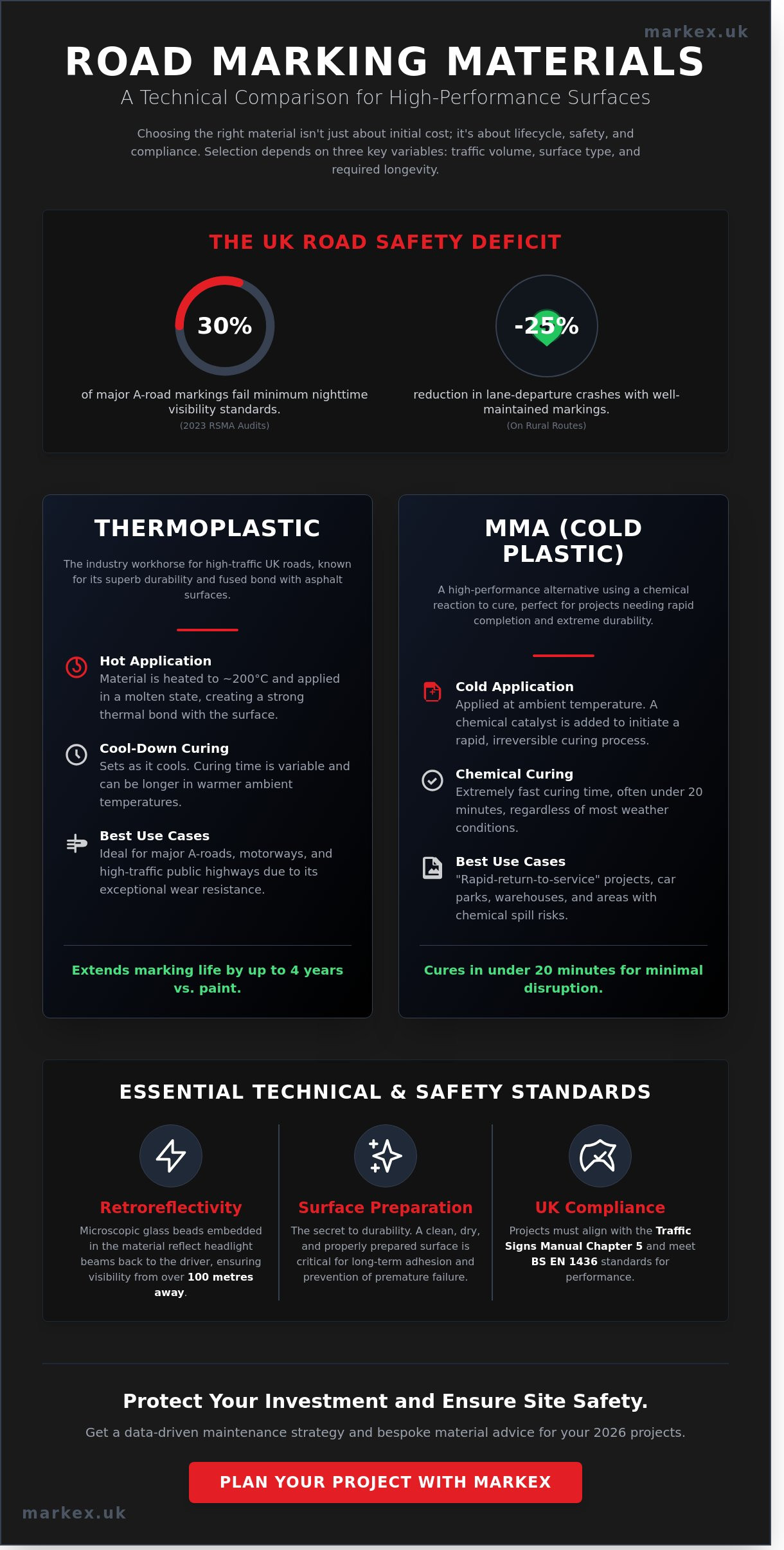
Nearly 30% of UK road markings on major A-roads fail to meet the minimum visibility standards required for nighttime safety, according to 2023 RSMA audits. It’s a frustrating reality for facility managers and local authorities who see maintenance budgets evaporate when lines fade within months of application. If you’ve dealt with premature wear or confusing HSE compliance checklists, you know that subpar road surface marking is a liability your project can’t afford.
We agree that clarity shouldn’t be a luxury. You need markings that withstand heavy HGVs and unpredictable British weather without requiring a total overhaul every single season. This guide provides the data-driven roadmap you need to master technical requirements and material choices for your 2026 projects. We’ll explore high-durability thermoplastics, bespoke application techniques, and the exact legal standards that ensure your site remains fully compliant. By the end of this article, you’ll have a clear, cost-effective plan to maintain high-visibility surfaces that protect both your visitors and your bottom line.
For developers looking to integrate these markings into a broader transport strategy, ML Traffic Engineers provides the expert planning documentation required for complex 2026 projects.
Key Takeaways
- Navigate UK safety standards with confidence by aligning your projects with the Traffic Signs Manual Chapter 5 and BS EN 1436.
- Optimise your material selection for maximum ROI by comparing high-performance Thermoplastic and MMA to find the bespoke solution for your traffic volume.
- Master the precision application process from the ground up. Discover why expert surface preparation is the secret to durable road surface marking and long-term adhesion.
- Protect your investment with a data-driven maintenance strategy. Learn to identify early signs of failure like loss of reflectivity to avoid costly repairs and maintain site safety.
Understanding Road Surface Marking: More Than Just Lines on Asphalt
Effective road infrastructure relies on more than just solid tarmac. It requires a clear, visual language that speaks to every driver instantly. Road surface marking serves as the primary navigational tool on UK roads, acting as a silent conductor for traffic flow. These markings aren’t merely decorative. They’re high-performance safety features. In 2022, data indicated that well-maintained horizontal signage can reduce lane-departure crashes by approximately 25% on rural routes. This data-driven reality proves that clear lines save lives.
Modern markings rely on retroreflectivity to maintain safety after dark. By embedding thousands of microscopic glass beads into the material, the surface reflects headlight beams back to the driver. This technology ensures that a lane remains visible from over 100 metres away, even during heavy rain. While public highways must meet strict TSRGD (Traffic Signs Regulations and General Directions) standards, private commercial facilities face their own set of challenges. Warehouses and retail car parks require bespoke layouts to manage pedestrian safety and vehicle logistics, often following HSE guidelines to mitigate workplace risks and ensure operational scaling.
The Core Functions of Horizontal Signage
- Delineation: You need clear boundaries. These markings define lane edges and central dividers, providing constant guidance that keeps vehicles in their intended paths.
- Warning: These symbols act as an early alert system. They signal upcoming hazards like sharp bends, school zones, or junctions before the driver reaches the physical obstacle.
- Instruction: Directing movement is about clarity. Arrows, stop lines, and speed roundels tell drivers exactly what to do, removing guesswork from complex intersections.
Why Precision Matters in Marking Projects
Inaccurate markings create immediate liability. If a stop line is misplaced by just 30 centimetres, it can obscure a driver’s sightline, leading to avoidable collisions. Professional application isn’t just about aesthetics; it’s about rigorous risk management. Using high-grade thermoplastics or cold plastic materials reduces long-term maintenance costs by extending the life of the marking by up to 4 years compared to standard paints. A professional road surface marking is a precision-engineered safety system designed to facilitate movement and protect lives through technical excellence.
Comparing High-Performance Marking Materials: Thermoplastic vs. MMA
Choosing the right road surface marking material isn’t just about the initial cost. It’s about the lifecycle of the infrastructure. In the UK, materials must withstand high axle loads and unpredictable weather. Selection depends on three variables: traffic volume, surface type, and budget. A car park with 50 cars a day requires a different solution than a busy A-road handling 30,000 vehicles daily.
The industry is moving toward low-VOC (Volatile Organic Compound) options. This shift reduces environmental impact without sacrificing performance. Climate plays a huge role here. Temperature and humidity dictate how well a material bonds. For example, a damp November morning can double curing times for traditional paints, while modern polymers offer more flexibility. Our team provides bespoke advice on material selection to ensure your project stays on budget and on schedule.
Thermoplastic: The Industry Standard for Durability
Thermoplastic remains the workhorse of UK roads. It’s the preferred choice for high-traffic areas because of its incredible wear resistance. The application process involves heating solid blocks to approximately 200°C. This molten material creates a fused thermal bond with the bitumen. We integrate glass beads into the mix to ensure immediate retroreflectivity. This ensures the road surface marking is visible to drivers the moment the road reopens, meeting BS EN 1436 safety standards.
Cold Plastics and MMA (Methyl Methacrylate)
MMA is the high-performance alternative for environments requiring extreme durability. Unlike thermoplastic, it’s cold-applied. It uses a chemical catalyst to cure rather than heat. MMA is exceptionally tough and resists chemical spills better than most materials. It’s a data-driven choice for “rapid-return-to-service” projects. While thermoplastic might take longer to cool in summer, MMA often cures in under 20 minutes. This speed reduces road closure times and minimises traffic disruption.
Water-Based and Solvent-Based Paints
Standard paints still have a place in the UK market. They are ideal for temporary markings or low-traffic zones like private warehouses. These materials are cost-effective but lack the longevity of modern polymers. They don’t offer the same skid resistance or thickness as MMA. You can find detailed specifications for these coatings in our UK road markings guide. We recommend these for projects where budget is the primary constraint and heavy wear isn’t expected.
Compliance and Safety: Navigating the UK Traffic Signs Manual
Safety on UK roads relies on a data-driven approach to visibility and friction. The Traffic Signs Manual Chapter 5 provides the legal framework for every road surface marking project. It isn’t just a guide; it serves as the primary benchmark for inspections and legal liability under the Road Traffic Regulation Act 1984. Contractors must adhere to these specifications to ensure public safety and avoid the risks of non-compliance.
Performance is measured against BS EN 1436, the European standard adopted by the UK. This standard defines how a marking behaves under different conditions. We focus on three critical KPIs to ensure long-term success:
- Luminance: This measures the contrast between the marking and the road surface, ensuring visibility during daylight and under street lighting.
- Durability: This tracks the material’s ability to withstand high traffic volumes without significant wear or loss of retroreflectivity.
- Skid Resistance (SRV): This determines the friction level provided to prevent vehicles and pedestrians from slipping, especially in wet conditions.
For private operators, compliance extends to Health and Safety Executive (HSE) guidelines. Warehousing facilities and private car parks must use bespoke marking strategies to separate pedestrians from heavy machinery. Clear reporting and transparent planning ensure these sites remain incident-free and legally sound.
Chapter 5 Specifications for Road Markings
Consistency creates clarity for drivers. Chapter 5 dictates standard dimensions, such as the 100mm width for standard lane lines or 150mm for higher-speed routes. Colour coding follows strict rules to prevent confusion. White indicates traffic flow or separation, while yellow marks waiting restrictions. Red signifies “no stopping” zones. Reflective studs, commonly known as cat’s eyes, must follow specific spacing intervals. These are often set at 9-metre or 18-metre gaps depending on the road type to provide essential night-time guidance.
Skid Resistance and Pedestrian Safety
Anti-skid surfacing is a non-negotiable requirement for pedestrian crossings and high-stress junctions. We measure this effectiveness using the Pendulum Test Value (PTV). A PTV of 45 or higher is typically required for standard road surface marking, while high-risk areas like school zones often require a PTV of 60 or more. In a 2022 safety audit, one UK facility reduced slip-related incidents by 34% simply by upgrading to high-friction markings. This proactive approach protects lives and reduces insurance liability for site owners.
The Precision Application Process: From Surface Prep to Removal
Precision is the difference between a marking that lasts five years and one that fails after the first winter. Professional road surface marking relies on a data-driven approach to every square metre of asphalt. We don’t just “paint lines”; we engineer a bond between the material and the road surface. This process starts long before a single drop of thermoplastic hits the ground.
The choice between mechanical and hand-applied techniques depends on the project’s scale. For motorways and trunk roads, modern truck-mounted extrusion machines use laser-guided systems to maintain a 2mm tolerance on line width and spacing. For bespoke layouts or intricate car park symbols, hand-moulded application provides the necessary finesse. Both methods require a stable, clean environment to ensure the result meets BS EN 1824 standards for durability and performance.
Steps to a Successful Marking Installation
Success starts with a comprehensive site survey and CAD-based layout planning. This ensures every line aligns perfectly with the existing infrastructure. Before application, the crew must remove all oil, grit, and moisture. Surface preparation accounts for 50% of a markings lifespan. On aged asphalt or concrete, we apply high-bond primers to prevent delamination. This proactive step creates a chemical bridge that secures the marking against heavy HGVs and relentless weather cycles.
Methods of Road Marking Removal
Decommissioning old lines is as critical as installing new ones. Improper removal leads to “ghost markings,” which confuse drivers and cause safety hazards during wet or low-light conditions. We use several bespoke methods to ensure a clean finish without compromising the structural integrity of the road:
- Hydro-blasting: This uses ultra-high-pressure water (often exceeding 40,000 PSI) to needle away the marking without damaging the road’s texture.
- Thermal lancing: Effective for thermoplastic, this uses high-heat compressed air to melt and lift material.
- Mechanical scabbling: A physical grinding process used when a specific texture is required after the material is removed.
These techniques ensure the road remains intact and ready for its next configuration. If you’re looking for a transparent, no-nonsense approach to your next project, you can explore our bespoke marking solutions to see how we deliver measurable results through technical expertise.
Strategic Maintenance: Maximising the Lifespan of Your Markings
Effective maintenance isn’t about repainting when lines disappear; it’s about a data-driven strategy that prevents failure before it starts. Reactive repairs often cost 40% more than scheduled interventions because they require extensive surface preparation and emergency mobilization. By implementing a fixed schedule, you ensure your road surface marking remains compliant with UK safety standards while protecting your bottom line from unexpected spikes in expenditure.
Identifying early signs of degradation is vital for long-term cost control. You should look for three primary indicators of failure: cracking, peeling, and a noticeable loss of reflectivity. In high-traffic commercial zones, reflectivity levels can drop below the required 100 mcd/m²/lx within 18 to 24 months. Markex Ltd delivers bespoke, fixed-price solutions for national projects, replacing guesswork with clear, evidence-based maintenance cycles. This proactive approach keeps your facility operational and ensures your site remains safe for both vehicles and pedestrians.
Inspecting and Auditing Your Surface Lines
Annual reflectivity tests and visual audits are non-negotiable for high-use areas like distribution centres or retail parks. We recommend addressing pothole repairs and structural surface issues before any re-marking takes place. Applying new material over a failing substrate is a wasted investment; the bond will only be as strong as the layer beneath it. For schools and sports facilities, specialized maintenance focuses on slip resistance. We ensure that high-friction coatings meet the BS EN 13036-4 standards, keeping children safe during play by maintaining a Pendulum Test Value (PTV) above 36.
Choosing a Specialist Marking Contractor
Selecting a partner with 40 years of industry experience provides a level of reliability that newer firms cannot match. Large-scale infrastructure requires a specialized machinery fleet capable of handling diverse materials from thermoplastic to cold plastic across multiple UK locations. For operators looking to streamline their own equipment maintenance through bulk fuels and lubricants, you can find out more about professional fleet support, while Mobile Tyres Bolton provides 24/7 mobile tyre fitting to keep your commercial fleet road-ready. You should evaluate contractors based on their certifications and their ability to provide transparent, fixed-price quotes that eliminate budget “creep” during the project.
We pride ourselves on a no-nonsense approach to project management. Our team focuses on delivering measurable results and clear reporting, ensuring your infrastructure supports your growth goals without hidden costs or delays. We believe in building long-term partnerships through honest communication and technical excellence. Partner with Markex for your next nationwide marking project to experience a professional, data-backed approach to road surface marking and estate management.
Secure Your Site with High-Performance Standards
Effective road surface marking is more than a legal requirement; it’s a strategic asset for safety and traffic flow. Choosing the right material, such as high-durability MMA or versatile thermoplastic, ensures your project meets the strict criteria set out in the UK Traffic Signs Manual. Precision application and proactive maintenance schedules are the only way to maximize the lifespan of these markings while maintaining total regulatory compliance. Reliability comes from evidence, not intuition.
Markex provides the clarity you need to move forward with confidence. We leverage 40+ years of specialist contracting experience to deliver results that stand up to heavy use and harsh British weather. Our dedicated machinery fleet offers nationwide UK coverage, ensuring we reach your site wherever it’s located. We operate on a fixed-price project contracting basis, so you’ll never deal with hidden fees or unexpected costs. We focus on transparent, measurable outcomes that protect your investment and your users.
Get a bespoke, data-driven quote for your road marking project
We’re ready to help you scale your infrastructure with professional markings that last.
Frequently Asked Questions
How long does road surface marking take to dry?
Thermoplastic road surface marking typically dries within 2 to 5 minutes of application. This rapid cooling allows traffic to resume almost immediately, which minimizes road closure times. Cold plastic and chlorinated rubber paints take longer, often requiring 20 to 30 minutes depending on the ambient temperature. We prioritize these fast-setting materials to ensure your site remains operational and safe with minimal downtime.
Can road markings be applied in wet weather?
You can’t apply road markings on wet or damp surfaces because moisture prevents the material from bonding correctly. Surface moisture levels must be below 5% for a successful installation. If we encounter rain, we pause the work or use thermal lances to dry the tarmac manually. Applying materials to a wet road leads to premature peeling and a 40% reduction in the marking’s lifespan.
What is the difference between thermoplastic and cold plastic markings?
Thermoplastic is a solid material heated to 200°C before application, while cold plastic uses a chemical catalyst to harden at ambient temperatures. Thermoplastic is the standard for most UK highways due to its cost-efficiency. Cold plastic offers superior durability in high-stress areas like roundabouts, lasting up to 3 times longer than standard thermoplastic under heavy braking conditions.
How much does road surface marking cost per metre in the UK?
Line marking costs in the UK typically range from £1.50 to £5.00 per linear metre depending on the project scale and material choice. Small-scale car park projects often carry a minimum call-out fee between £350 and £500 to cover equipment transport and site setup. Larger highway projects benefit from economies of scale, reducing the price per metre for bulk thermoplastic applications.
What happens if road markings are not compliant with the Highway Code?
Non-compliant road markings can lead to legal liability and a 100% failure rate during local authority inspections. If a marking doesn’t meet the Traffic Signs Regulations and General Directions 2016 standards, it’s legally unenforceable. This means local councils can’t issue fines for parking violations, and private landowners face increased risk in personal injury claims if an accident occurs on their property.
Is it possible to remove old road markings without damaging the road?
We remove old markings using high-pressure hydro-blasting or thermal lancing to preserve the underlying road surface. Hydro-blasting uses water jets at 40,000 psi to strip the material without the abrasive damage caused by traditional mechanical grinding. This method captures 95% of the debris, leaving the tarmac intact and ready for a fresh application of road surface marking immediately.
How often should car park lines be repainted for maximum safety?
Most commercial car parks require repainting every 3 to 5 years to maintain visibility and safety standards. High-traffic areas like entrance ramps or supermarket bays may need attention every 24 months due to constant tyre friction. Monitoring the skid resistance ensures your facility complies with British Standard BS EN 1436, which dictates the performance requirements for all UK road users.
Can you apply new road markings over old ones?
You can apply new markings over existing ones if the old material is still well-bonded to the road. We perform a physical adhesion test to check the surface integrity before proceeding. If more than 20% of the old line is flaking or worn away, we recommend full removal first. Laying new material over a failing base causes the new line to peel within 6 months.