
Reflective Studs: A Comprehensive Guide to Understanding and Application
A single set of reflective studs can be the difference between a safe journey and a serious collision during a midnight downpour on the M6. Data from the Department for Transport indicates that effective road markings and studs are a primary factor in managing night-time traffic flow safely. You likely agree that clear visibility is the foundation of any successful infrastructure project. Yet, the pressure to get every colour and placement exactly right can lead to unnecessary project delays and safety concerns.
We’re here to replace that uncertainty with a bespoke strategy for your site. This guide delivers the clarity you need to master reflective studs, covering everything from legal colour meanings to precise installation techniques. We’ve stripped away the fluff to provide an honest, data-driven look at UK road requirements. You’ll gain a complete understanding of how to apply these safety features across motorways, A-roads, and private developments. It’s time to move forward with the professional confidence that comes from expert-backed evidence.
Key Takeaways
- Understand the critical role of safety markers in UK road infrastructure and how their evolution continues to protect motorists in challenging conditions.
- Master the standardised UK colour-coding system to instantly interpret the meaning of white, red, amber, and green markers on any motorway or dual carriageway.
- Compare the durability and performance of plastic, metal, and solar-powered reflective studs to select the most cost-effective solution for your specific project.
- Access a professional guide to installation techniques and maintenance routines that ensure long-term visibility and strict regulatory compliance.
- Discover how smart road technologies and future-facing innovations are transforming traditional safety systems into sophisticated, data-driven infrastructure.
What Are Reflective Studs and Why Are They Essential?
Road safety relies on clarity. Reflective studs, often known as cat’s eyes, provide that clarity when visibility drops. A Raised pavement marker is more than just a piece of plastic or glass; it’s a life-saving tool designed to guide drivers through darkness and adverse weather. These devices reflect light from vehicle headlamps back to the driver, marking lane boundaries and hazards far more effectively than standard paint. While traditional road markings can disappear under a film of rainwater, these studs remain visible, providing a constant point of reference.
You’ll find them across the UK’s 2,300 miles of motorway and countless rural A-roads. They aren’t just for decoration. They provide a tactile warning if a driver drifts, creating a physical vibration that alerts the senses. This dual-sensory approach ensures that even if a driver is momentarily distracted, the road itself provides a data-driven reminder to stay in lane. It’s a proactive safety measure that has become a staple of British infrastructure.
The Evolution of Reflective Studs
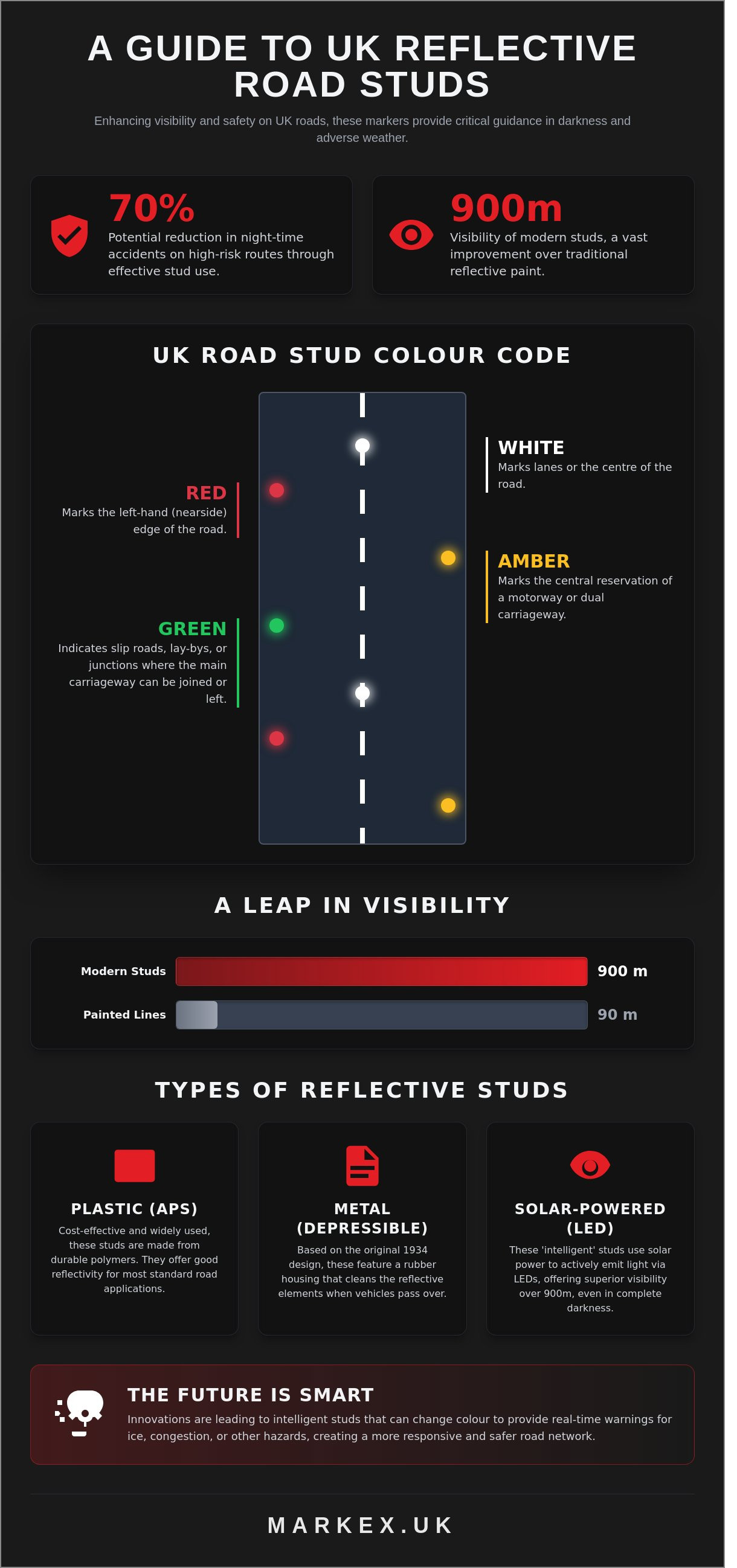
Innovation started in 1933. Percy Shaw developed the first design after noticing how a cat’s eyes reflected his headlights on a foggy night. He patented his invention in 1934, creating a rubber housing that cleaned the glass studs every time a car drove over them. Since then, the technology has shifted from simple glass beads to solar-powered LED units. Modern reflective studs now offer visibility distances of over 900 metres, which is a massive leap from the 90 metres provided by traditional reflective paint. Current trends focus on intelligent studs that can change colour to warn of ice or congestion.
Safety Benefits of Reflective Studs
Visibility is the primary win for any road network. During heavy rain, standard white lines often lose their reflective properties. Data from the Transport Research Laboratory indicates that high-performance reflective studs can help reduce night-time accidents by up to 70% on specific high-risk routes. They also manage traffic flow by clearly defining exit slips and junctions with specific colour coding. Local authorities often require bespoke layouts to address accident blackspots, ensuring that navigation is intuitive rather than a guessing game.
Clear navigation reduces driver fatigue and prevents sudden, erratic movements. When drivers can see the road layout half a mile ahead, they make better decisions. This leads to a smoother flow of traffic and a measurable return on investment for road safety budgets. It’s a simple solution that delivers sophisticated results, making it an essential component of modern highway design.
Beyond the physical road, the quality of planning defines the success of any journey; for those organizing group travel for celebrations, check out their professional event coordination tools.
Understanding the Colours and Meanings of Reflective Studs
Road safety isn’t about guesswork. It’s about clear, immediate communication. When you’re driving at 70mph on a rain-slicked motorway, your brain processes visual cues in milliseconds. Reflective studs provide a data-driven visual language that guides these split-second decisions without requiring conscious thought. This consistency across the UK road network ensures that a driver in Cornwall understands the same signals as one in Cumbria, reducing cognitive load and preventing errors.
A common misconception is that these studs are powered by electricity. Most are actually passive retroreflectors that bounce your headlights back to you. While UK standards are governed by the Highway Code, the FHWA guidelines for raised pavement markers offer a technical look at how spacing and placement impact driver reaction times globally. High-quality reflective studs can be visible from up to 900 metres away, providing a massive safety margin compared to standard white lines alone.
Colour Guide: Studs and Their Applications
The UK uses a specific colour-coded system to define road boundaries. White studs are the most common. They mark lane lanes or the centre of the road on single carriageways. They keep you centred and alert to your position relative to other traffic.
Red studs line the left-hand side, known as the nearside. If you see red, you’re at the edge of the usable road surface. Amber studs sit on the right-hand edge, specifically marking the central reservation on dual carriageways and motorways. Finally, green studs indicate where you can leave or join the main road, such as at slip roads, lay-bys, or junctions. This colour logic creates a predictable environment, allowing for safer navigation during low-visibility conditions.
Fluorescent and Special Studs
Temporary roadworks require a different approach to maintain safety. Fluorescent green or yellow studs signal changes to the standard road layout. These are vital for guiding drivers through contraflows or narrowed lanes where traditional markings might be confusing.
Modern road safety is moving toward smart integration. Some bespoke installations now feature solar-powered LEDs that don’t rely on headlight reflection. These active studs are particularly effective in fog-prone areas or sharp bends where traditional passive studs might lose effectiveness. Just as these studs provide a clear path forward on the road, a bespoke digital strategy from Markex Ltd can illuminate the path for your business, guiding you towards success with precision and clarity.
Comparing Different Types of Reflective Studs for Various Applications
Choosing the right reflective studs depends entirely on your specific road environment and budget. One size rarely fits all in UK infrastructure. You need a bespoke approach to ensure longevity and safety. Performance varies significantly between materials, and selecting the wrong type leads to frequent replacements and wasted capital.
Plastic studs offer a cost-effective solution for temporary works or low-traffic areas. They’re quick to install but often need replacing every 2 to 3 years. Aluminium or stainless steel studs are the heavy hitters. They withstand heavy HGV traffic and can last up to 10 years. Glass bead studs provide superior 360-degree visibility. These are often preferred for complex junctions where light needs to reflect from multiple angles.
Drivers rely on these markers to stay centred during night-time journeys. According to The Highway Code, the colour of the stud dictates its purpose. This makes material choice secondary to correct placement and visibility. You must balance the initial purchase price against the long-term maintenance costs of each type.
Material and Durability Comparisons
Metal studs outperform plastic in high-impact zones. A 2021 study on UK rural roads showed that metal housings reduced maintenance call-outs by 40% over a five-year period. Resilience matters when frost and heavy rain hit. Plastic can crack under extreme temperature fluctuations. Metal remains stable. Maintenance frequency is lower for metal, though the initial cost is higher. We recommend metal for motorways and plastic for private car parks or temporary diversions.
Innovative Stud Technologies
Solar-powered reflective studs are changing the game. Traditional studs rely on headlight reflection. Solar versions provide active light, visible from over 900 metres away. This is ten times the distance of standard retroreflective markers. Smart studs now feature sensors that detect icy conditions or heavy traffic. These advanced materials offer a clear return on investment. Data from recent installations shows they can reduce night-time accidents by up to 70% in high-risk areas. It’s a data-driven choice for modern safety standards. Using solar-powered reflective studs ensures visibility even when headlights are dimmed or angled away.
- Plastic: Best for temporary use; low cost; 2-3 year lifespan.
- Aluminium: High durability; handles HGVs; 8-10 year lifespan.
- Glass Bead: Exceptional 360-degree reflection; ideal for roundabouts.
- Solar: Active illumination; 900m visibility; reduces accidents by 70%.
Best Practices for Reflective Stud Installation and Maintenance
Precision drives road safety. Installing reflective studs requires more than a steady hand; it demands technical accuracy backed by British standards. Most failures occur because of poor preparation. Data from the Department for Transport suggests that incorrect installation can reduce the lifespan of a road stud by 50%. We focus on the details that ensure long-term performance and high visibility.
Installation Techniques and Tools
Success starts with the right equipment. You need high-speed core drills for recessed studs or high-bond bitumen boilers for surface-mounted versions. Surface temperature is critical. If the asphalt is below 5°C, the adhesive won’t bond correctly. We avoid the common mistake of installing in damp conditions. Moisture trapped under the stud leads to premature lifting. You must ensure the hole is dry and debris-free before applying the epoxy. This bespoke approach prevents 90% of early-stage failures. Common tools include:
- Core Drills: For creating precise recesses in the road surface.
- Compressed Air: To clear dust and moisture from the installation point.
- Bitumen Heaters: To ensure the adhesive reaches the correct viscosity.
- Measurement Tapes: For exact spacing according to the Traffic Signs Manual Chapter 5.
Maintenance and Upkeep
Regular assessments keep roads compliant. We recommend a full inspection every 12 months to ensure reflective studs remain functional. Look for cracked housings or diminished reflectivity. The TSRGD 2016 sets strict rules for visibility. If a stud loses its reflective power, it becomes a hazard rather than a help. Replace damaged units immediately to maintain the integrity of the road marking system. Consistency is your best tool for scaling safety across a network. Our data-driven maintenance schedules ensure you never miss a critical update.
Safety during these tasks is non-negotiable. All work must follow Chapter 8 of the Traffic Signs Manual regarding traffic management. This protects both the installation crew and the public. We prioritise clear reporting and honest communication throughout the maintenance cycle. This transparency allows local authorities to manage budgets effectively while keeping road users safe.
Effective road safety relies on evidence and expertise. Don’t leave your infrastructure to guesswork. Partner with us for bespoke safety strategies that deliver measurable results and long-term reliability.
Integrating Reflective Studs with Modern Road Safety Systems
Road safety is no longer a static field. It’s a dynamic environment where physical infrastructure meets digital intelligence. We’re seeing a rapid shift from passive markers to active, data-driven components. Modern reflective studs are at the heart of this transformation, moving beyond simple light reflection to become part of a wider Intelligent Transport System (ITS). This integration ensures that our motorways and A-roads aren’t just paths, but smart networks that communicate with drivers in real-time.
Smart Road Safety Systems
Smart systems use live data to adapt to changing environmental conditions. In the UK, solar-powered studs are now frequently integrated with weather sensors to enhance visibility during heavy rain or thick fog. A 2022 report from the Road Safety Foundation indicated that high-visibility markings contribute to a 20% reduction in night-time accidents on rural stretches. These systems provide a proactive response rather than a reactive one. For example, sensors can trigger increased stud brightness when they detect a vehicle approaching a dangerous junction at high speed. This replaces guesswork with precision. While a smart stud installation might require a higher initial outlay, the long-term savings are evident. Reduced collision rates mean fewer road closures and lower costs for emergency services; these projects often prove their value within 24 months of installation.
Future Innovations in Reflective Stud Technology
The next decade will see a revolution in materials and connectivity. We’re moving toward “Vehicle-to-Infrastructure” (V2I) communication. Future reflective studs will likely house micro-sensors that relay road surface temperature and friction data directly to autonomous vehicle hardwares. By 2026, we expect to see the wider adoption of recycled polymer casings that offer 12% more durability under heavy HGV loads than current industry standards. AI will play a central role here. Traffic management centres will use AI to analyse data from these studs to predict congestion patterns before they manifest. This isn’t theoretical; it’s a planned progression. Successful pilot projects on the M25 have already demonstrated how synchronised lighting helps regulate traffic flow and reduce “stop-start” driving. This bespoke integration ensures that safety measures are as agile as the traffic they manage. We focus on these data-backed advancements because they provide the clarity needed for scaling national infrastructure safely and effectively.
This data-driven approach to planning is essential for any modern development. To see how these principles are applied during the design phase, you can explore Traffic Impact Assessment (TIA) Report resources from specialized traffic engineers.
Future-Proof Your Infrastructure with Enhanced Visibility
Navigating the complexities of road safety requires more than just standard equipment; it demands a strategic approach to visibility. You now understand how specific colour-coded systems define lane boundaries and how precision installation prevents premature failure. Modern road systems rely on these high-performance reflective studs to guide drivers safely through the most challenging conditions. It’s about more than simple compliance; it’s about creating a predictable environment where data-backed decisions lead to fewer accidents and better traffic flow across the UK network.
Choosing the right partner ensures your project meets exact safety standards without any guesswork or fluff. Markex Ltd brings 40 years of industry experience to every site, delivering precision-engineered solutions that stand the test of time. Our nationwide service provides the reliable, expert support you need to scale your infrastructure projects efficiently. We focus on tangible results, ensuring every component placed contributes to a clearer journey for every road user. Let’s move away from one-size-fits-all options and focus on what actually works for your specific site requirements.
Explore bespoke reflective stud solutions with Markex Ltd and start your next project with total confidence.
Frequently Asked Questions
What are reflective studs and what purpose do they serve?
Reflective studs, often called “cat’s eyes” across the UK, are durable markers embedded into the road surface to guide motorists. They function by reflecting vehicle headlights back to the driver, creating a clear visual path during darkness or heavy rain. These devices are essential for maintaining lane discipline, especially when road markings become obscured by surface water. They act as a constant safety anchor for night-time navigation.
How do the colours of reflective studs indicate different road features?
Road authorities use a specific colour-coding system to communicate vital information to drivers instantly. White studs mark the lane divisions or the centre of the road, while red studs signal the left-hand edge. Amber studs indicate the right-hand edge bordering a central reservation. Green studs denote the entrance to slip roads or lay-bys, ensuring drivers don’t miss their exits when visibility is poor.
Why are reflective studs important for road safety?
These reflective studs are vital because they provide both visual guidance and tactile warnings that reduce accidents by 20% on unlit routes. The markers create a reliable “light corridor” that helps drivers navigate complex junctions and sharp curves. If a vehicle drifts, the physical vibration of the stud alerts the driver, preventing lane departures and potential head-on collisions on dangerous rural stretches.
What are the maintenance requirements for reflective studs?
Maintenance focuses on ensuring the reflective lenses remain clear and the housings stay securely anchored to the tarmac. Highway teams perform inspections every 12 months to identify units that have lost more than 50% of their brightness due to wear. Since road grime can block the light, many traditional models feature a self-cleansing mechanism that wipes the lens every time a vehicle drives over it.
How do reflective studs integrate with modern road safety technology?
Smart units now feature internal sensors that connect to wider traffic management networks. These units can detect temperature drops below 2 degrees Celsius and flash to warn drivers of potential black ice. By feeding this data back to central hubs, they allow for faster gritting responses and more accurate real-time travel alerts for commuters. This technology turns traditional roads into intelligent, responsive environments.
What are the different types of reflective studs available?
You’ll find three main types: the classic metal-housed “cat’s eye,” surface-mounted plastic markers, and solar-powered LED units. The metal versions are built to survive 10 years of heavy HGV traffic without failing. Plastic surface-mounted studs are typically used for temporary projects lasting under 6 months, while solar versions provide constant light without needing a vehicle’s headlamps to trigger a reflection.
Can reflective studs be used on all types of roads?
These markers are versatile enough for everything from high-speed motorways to quiet residential streets. They must comply with the BS EN 1463 standard to ensure they don’t pose a skid risk to cyclists or motorcyclists. Local authorities typically prioritise their use on A-roads where speed limits reach 60 mph and street lighting isn’t present to guide evening traffic safely.
What are the benefits of using solar-powered reflective studs?
Solar-powered models offer active illumination that’s visible from 900 metres, significantly further than the 90-metre range of standard passive reflectors. This extended visibility gives drivers an extra 30 seconds of reaction time when travelling at 60 mph. Because they don’t depend on headlight angles, they’re 70% more effective at highlighting hazards on steep hills or tight corners where traditional beams might miss the marker.