
Professional Road Marking Contractors: A Strategic Guide to UK Surface Safety
Did you know that nearly 30% of surveyed UK road markings on major routes fall below the minimum visibility levels required for safe navigation? This isn’t just a cosmetic issue. It’s a direct threat to site safety and legal compliance that can lead to significant HSE penalties. You already know that faded lines cause confusion and near-misses on-site. It’s frustrating when operations grind to a halt just to refresh paint that wears away within six months. You need a solution that lasts without the constant cycle of disruption.
Choosing the right road marking contractors is about more than just a fresh coat of paint. It’s about securing a strategic partner who understands the nuances of British Standards like BS EN 1871. In this guide, you’ll discover how to evaluate contractors to ensure long-term durability, full regulatory compliance, and high-visibility results. We’ll preview the essential criteria for selection, focusing on bespoke installation schedules that minimise operational downtime and keep your site moving safely. We’ll show you how to move from guesswork to a data-driven approach for your surface safety.
Key Takeaways
- Master the strategic role of surface markings as a primary safety tool rather than just an aesthetic addition to your infrastructure.
- Identify the specific materials and advanced machinery required to ensure your markings withstand heavy traffic and harsh UK weather conditions.
- Learn how to navigate British Standards and safety accreditations to guarantee full regulatory compliance and mitigate site risks.
- Evaluate road marking contractors using a bespoke framework that prioritises long-term durability and total cost of ownership over the lowest initial bid.
- Gain insights into data-driven project reporting that eliminates guesswork and provides transparent, measurable results for national-scale delivery.
The Strategic Role of Road Marking Contractors in Modern Infrastructure
Road markings are far more than simple lines on asphalt. They represent a sophisticated layer of site intelligence that dictates how people and vehicles interact within a space. For businesses across the UK, hiring expert road marking contractors isn’t just a maintenance task. It’s a strategic investment in operational flow. Professional contractors look beyond aesthetics to ensure every thermoplastic line and epoxy spray aligns with 2024 UK transport regulations and site-specific needs.
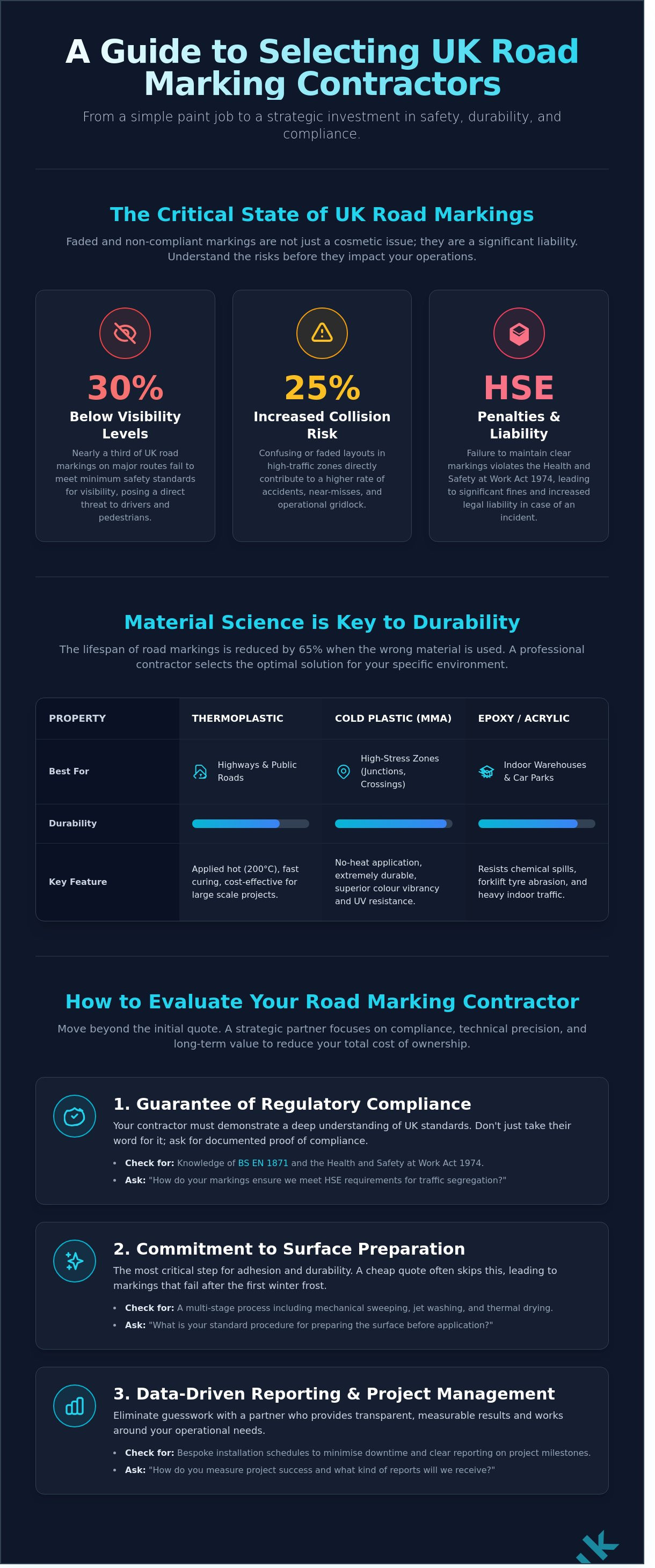
Clear markings serve as the primary defence against site accidents. When a facility has faded or confusing layouts, the risk of collision increases by up to 25% in high-traffic zones. Professional contractors integrate their work into broader construction programmes, ensuring that new surfaces are protected and functional from day one. This proactive approach reduces the legal liability for facility managers, as documented evidence of compliant markings is a key factor in insurance assessments and personal injury claims. It’s about moving from reactive fixes to a bespoke, data-driven safety strategy.
Risk Mitigation and HSE Compliance
Maintaining visible safety markings isn’t optional under the Health and Safety at Work etc Act 1974. It’s a legal obligation. Site owners must ensure that high-traffic commercial environments, such as distribution centres or retail parks, have clear segregation. Professional road marking contractors help businesses meet these UK standards by applying durable, high-friction materials that withstand heavy axle loads. These markings prevent workplace accidents by providing undeniable visual boundaries, ensuring that 100% of staff and visitors understand the rules of the road on your private property. We don’t rely on guesswork; we apply precise markings that satisfy HSE inspectors and protect your bottom line.
A comprehensive approach to facility safety includes both exterior markings and interior cleanliness; to maintain your indoor environments, you can learn more about Commercial Carpet Cleaners Stockport for professional upholstery and carpet care.
The Impact of Precision on Traffic Behaviour
Precision in line design creates psychological cues that naturally influence driver behaviour. Narrower lane markings or hatched “slow” zones can reduce vehicle speeds by an average of 15% without the need for physical speed bumps. In complex commercial car parks, organised layouts maximise space while ensuring pedestrian safety. By adhering to international road marking standards, contractors use specific colour-coded zones-such as bright yellow for no-parking and blue for disabled access-to create immediate clarity. This logical approach to layout design eliminates confusion, reduces congestion, and ensures that pedestrian and vehicle segregation is both intuitive and permanent.
Technical Excellence: Materials, Machinery, and Application Methods
Durability isn’t a happy accident. It’s the direct result of chemical engineering and mechanical precision. Choosing the wrong material can reduce the lifespan of a marking by 65% in high-traffic London zones. Professional road marking contractors understand that material choice dictates the entire ROI of a project. A “one-size-fits-all” approach fails because a residential cul-de-sac and a busy logistics hub have entirely different friction requirements. Surface preparation is the most critical step in the process. Without mechanical sweeping, jet washing, or thermal drying, even the most expensive thermoplastic won’t adhere to the substrate. It’s the difference between a marking that lasts five years and one that fails after the first winter frost.
- Surface Integrity: Removing oil, grit, and old paint is non-negotiable for maximum adhesion.
- Climate Considerations: Materials must be selected based on the UK’s specific moisture and temperature fluctuations.
- Stress Factors: High-braking zones require different aggregates than standard parking bays.
Thermoplastic vs. Cold Plastic and Epoxy
Thermoplastic is the workhorse of the UK road network. Applied at 200°C, it creates a thermal bond with the bitumen, allowing roads to reopen within minutes. It’s cost-effective and reliable for the majority of highway projects. For high-stress areas like roundabouts or busy pedestrian crossings, Cold Plastic (MMA) offers extreme durability without the need for heat. It’s particularly effective for vibrant safety colours that won’t fade under heavy UV exposure. In contrast, indoor environments like warehouses require Epoxy or Acrylic resins. These materials resist the corrosive effects of forklift tyres and industrial cleaning chemicals, ensuring safety lines remain sharp and visible for years.
Advanced Application Technology
Modern infrastructure requires more than a steady hand. Computer-controlled screed trucks deliver national-scale projects with 100% consistency in width and thickness. This level of automation eliminates the human error that leads to premature wear on major routes like the M25. However, bespoke projects like school playgrounds or sports courts still rely on hand-applied precision. This allows for intricate, multi-coloured designs that machines simply can’t replicate. Safety at night depends on retroreflectivity. By embedding microscopic glass beads into the wet material, road marking contractors ensure light reflects back to the driver. This process must meet strict BS EN 1436 standards, a benchmark championed by the Road Safety Markings Association. To ensure your next project uses the right technology for your specific site, you can consult our team for a bespoke assessment.
In addition to surface precision, high-accuracy tracking technology is also revolutionising modern indoor sports facilities; for those looking to upgrade their leisure amenities, you can explore VTrack Overhead Golf Launch Monitor to see how professional-grade data capture enhances performance tracking.
Regulatory Standards and Quality Assurance in the UK
Compliance isn’t a box-ticking exercise; it’s the foundation of public safety. Professional road marking contractors ensure every line meets the BS EN 1871 standard for material performance. This specification ensures that the thermoplastic or cold plastic used can withstand London’s heavy traffic volumes, which often exceed 50,000 vehicles per day on major arterial routes. Using inferior materials leads to rapid degradation and creates a cycle of constant, costly repairs.
Accreditations like CHAS and SafeContractor are essential markers of reliability. They provide a transparent audit trail of a contractor’s safety record and operational standards. For approximately 92% of local authority tenders in Greater London, these certifications are a mandatory prerequisite. They prove the contractor handles risk with the same precision they use to apply paint, giving you peace of mind that the site remains secure.
Environmental impact is now a core part of quality control. Leading contractors prioritise VOC-compliant materials to reduce atmospheric pollutants. This shift aligns with the London Mayor’s Environment Strategy, which targets a zero-carbon city by 2030. Sustainable application isn’t just about the paint; it involves efficient logistics that reduce the carbon footprint of the entire rollout.
- Bespoke Quality Audits: Top-tier firms use digital tracking to log material temperatures and application thickness in real-time.
- Durability Testing: High-performance markings are designed to last through at least 1.5 million wheel passages before requiring a refresh.
- Regulatory Alignment: Contractors must stay updated with the latest Traffic Signs Regulations and General Directions (TSRGD) 2016 updates.
Understanding BS EN 1436 Visibility Standards
BS EN 1436 serves as the official European benchmark for the performance of road markings for road users, based on luminance, colour, and skid resistance. Contractors measure the Skid Resistance Value (SRV) to ensure it stays above 45, which is the threshold for safety in wet conditions. Regular inspections are vital to track degradation. We recommend a formal performance review every 12 months to maintain compliance and protect your liability.
Health, Safety, and Site Management
Safety is non-negotiable on any London site. Every project requires a detailed Risk Assessment and Method Statement (RAMS). These documents outline how the road marking contractors will manage traffic flow and pedestrian safety without causing gridlock. Professional teams also carry a minimum of £10 million in public liability insurance. This protects your business from the financial fallout of accidental damage or site incidents, ensuring a no-nonsense approach to project delivery.
How to Evaluate and Select a Road Marking Contractor
Choosing the cheapest quote often leads to premature line failure or unexpected variations. You shouldn’t just look at the bottom line; you need to evaluate the total cost of ownership. A durable thermoplastic application might cost 15% more upfront, but it frequently lasts three times longer than budget paint alternatives. This translates to fewer site disruptions and lower maintenance costs over a five-year cycle for your facility.
Professional road marking contractors must demonstrate the scale to meet your specific deadlines. If you manage a portfolio across London and the South East, verify their ability to deploy multiple crews simultaneously. Reviewing case studies from the 2023 financial year will show if they have genuine experience in your sector, whether that’s high-volume logistics hubs or sensitive school zones. Bespoke site surveys are a vital part of this evaluation. Never accept a quote based on a Google Maps screenshot. A physical inspection identifies surface issues like oil contamination or loose aggregate that impact adhesion, ensuring your fixed-price quote remains accurate and transparent.
The Procurement Checklist for Facilities Managers
Safety and skill are non-negotiable. Verify that every operative holds a valid CSCS card and an NVQ Level 2 in Road Marking. This ensures technical competence and site safety. Consider these specific points during your procurement process:
- Technical Certifications: Confirm the contractor is accredited by bodies like the Road Safety Marking Association (RSMA).
- Fleet Capability: Check they have specialised machinery for narrow multi-storey car parks or high-friction surfacing requirements.
- Integrated Services: Confirm they offer line removal or anti-skid treatments. Using one partner for the entire project reduces scheduling friction.
Analysing the Fixed-Price Contract
A transparent proposal eliminates guesswork. It should clearly outline the materials used, the specific thickness of the application, and the expected drying times. Watch for hidden costs; some “cheap” quotes exclude surface preparation or add 20% surcharges for night shifts without making it clear upfront.
Clear timelines are the backbone of a successful project. Demand a weather-contingency plan that uses data to manage delays. Reliable road marking contractors account for the UK’s average 150 rainy days per year, ensuring your project doesn’t stall indefinitely when the weather turns. This level of clarity allows you to plan your operations with confidence.
Markex Ltd: Precision-Engineered Marking Solutions Nationwide
Markex Ltd brings over 40 years of technical expertise to every project we undertake. We don’t rely on guesswork or outdated methods. Instead, we deliver high-specification marking projects backed by a commitment to data-driven results. Our team provides transparent project reporting that gives you total clarity on progress and performance. This honest communication ensures that facility managers and business owners can make informed decisions based on evidence rather than intuition.
As leading road marking contractors, we handle everything from heavy-duty airport runways to vibrant school playgrounds. We treat every site as a unique challenge. The Markex Ltd approach centres on bespoke strategies tailored specifically to your facility’s layout and traffic demands. We avoid one-size-fits-all templates, opting instead for a collaborative process that places your operational success at the heart of our work. It’s a professional partnership designed to scale with your needs.
Comprehensive Surface Solutions
We provide a holistic approach to site maintenance by integrating line marking with essential services like pothole repair and anti-skid surfacing. This creates a seamless, durable finish that stands up to heavy use. If your site requires a fresh start, we offer specialist line removal using hydro-blasting technology. This method ensures a clean surface finish without damaging the underlying tarmac. While we are a primary choice for those seeking road marking contractors in London, our reach is nationwide. We maintain consistent quality across the UK, ensuring your brand standards are met regardless of location.
Why Strategic Partners Choose Markex Ltd
Our clients value our no-nonsense approach to complex site logistics. We understand that your business cannot afford lengthy delays. We focus on minimal disruption and rapid project turnaround to keep your operations moving. We work around your schedule to ensure safety and compliance are achieved without compromising productivity. You get a modern, energetic partner who values tangible progress and measurable ROI. We bridge the gap between complex technical requirements and your practical business needs.
Success in infrastructure starts with precision and ends with reliability. We provide the analytical expertise and creative problem-solving required for the most demanding environments. Request a bespoke quote for your next marking project today and experience a service built on four decades of excellence.
Future-Proof Your Site with Precision Markings
Maintaining safe, compliant surfaces is a strategic investment in the UK’s infrastructure. High-quality markings reduce accidents and ensure your site meets strict regulatory standards without the risk of non-compliance penalties. Choosing the right road marking contractors ensures you benefit from precision-engineered materials and durable application methods that stand the test of time. It isn’t just about paint on tarmac; it’s about creating a clear, navigable environment that protects every road user.
Markex Ltd brings over 40 years of industry experience to every project. We’re CHAS and SafeContractor accredited, providing the transparency and reliability you need to manage your assets effectively. Our team provides full UK-wide service coverage, delivering bespoke solutions tailored to your specific operational requirements. We reject guesswork in favour of proven technical excellence, ensuring your markings remain visible and effective for years to come. It’s time to bring clarity to your project with a partner you can trust.
Get a Fixed-Price Quote for Your Nationwide Marking Project
Frequently Asked Questions
What is the difference between road marking and line painting?
Road marking involves heavy-duty materials like thermoplastic or cold plastic designed for high-traffic durability on public highways. Line painting usually refers to thinner, acrylic-based applications better suited for temporary layouts or low-stress indoor environments. Professional contractors select materials based on the BS EN 1871 standard to ensure longevity. This distinction ensures your surface handles the 2,000 vehicles that might cross it daily without fading.
How long does thermoplastic road marking take to dry and be ready for use?
Thermoplastic road markings typically dry and become traffic-ready in under five minutes. This rapid cooling process allows for minimal disruption, letting vehicles return to the surface almost immediately after application. You’ll find that 90% of UK road projects use this material because it sets so quickly. It’s an efficient choice for busy London boroughs where closing a road for more than 15 minutes causes significant congestion.
What are the legal requirements for disabled parking bay markings in the UK?
Disabled parking bays must comply with the Traffic Signs Regulations and General Directions 2016. Standard bays require a minimum width of 3.6 metres, which includes a 1.2-metre safety zone for wheelchair access. You must also include the yellow or white wheelchair symbol to meet British Standard BS 8300-1:2018 requirements. These specific dimensions ensure your site remains accessible and legally compliant for the 16 million disabled people in the UK. For comprehensive guidance on UK road markings compliance and safety specifications, understanding these requirements is crucial for avoiding penalties and ensuring proper accessibility.
How often should commercial car park markings be refreshed for safety?
Commercial car park markings generally require a refresh every 2 to 3 years to maintain safety and visibility. High-traffic zones, like entrance ramps or loading bays, might need attention every 18 months to prevent accidents. Clear markings reduce the risk of collisions by 25% in busy retail environments. Regular audits ensure your site stays organised and avoids the liability risks associated with faded, confusing navigation.
Can road markings be applied in wet or cold weather conditions?
Road markings cannot be applied effectively on wet surfaces or in temperatures below 5 degrees Celsius. Moisture prevents the material from bonding correctly with the substrate, leading to premature peeling and failure. Expert road marking contractors use thermal lances to dry the ground if conditions are borderline. However, for 100% reliability, it’s best to schedule work during dry windows to ensure the bond meets industry standards.
What is the most durable material for warehouse floor markings?
Methyl Methacrylate (MMA) is the most durable material for warehouse floor markings due to its exceptional resistance to heavy forklift traffic. This cold-applied resin bonds chemically to the concrete, lasting up to five times longer than standard floor paints. It’s a bespoke solution for facilities handling 24/7 operations where downtime isn’t an option. MMA also resists chemical spills, making it the top choice for the 1.5 billion square feet of warehouse space in the UK.
How do contractors remove old road markings without damaging the surface?
Contractors remove old road markings using high-pressure hydroblasting or thermal lances to avoid damaging the underlying tarmac. Hydroblasting uses water jets at 40,000 psi to strip the paint without leaving the ghosting effects common with mechanical grinding. This precision ensures the new layout is clear and doesn’t confuse drivers. It’s a clean, data-backed method that preserves the structural integrity of your surface for years to come.
What certifications should I look for in a road marking contractor?
Look for road marking contractors with Road Safety Marking Association (RSMA) membership and CHAS or SafeContractor accreditation. These certifications prove the team follows the high safety standards required for UK infrastructure projects. You should also verify that their technicians hold NVQ Level 2 in Pavement Marking. Choosing a certified partner removes the guesswork from your project, ensuring you receive a transparent, high-quality result that meets all 2024 safety regulations. For detailed information on UK road markings standards and regulatory requirements, understanding these certifications helps ensure your contractor meets all necessary compliance criteria.