
The Comprehensive Guide to Runway Markings: UK Standards, Safety, and Installation in 2026
What if a single millimetre of paint thickness was the difference between a seamless landing and a costly CAA non-compliance penalty? Maintaining airfield infrastructure is a high-stakes balancing act. You’re likely juggling the need for absolute CAP 168 compliance with the practical reality of minimising aircraft downtime. According to 2024 safety audits, poor visibility of runway markings remains a primary factor in ground navigation errors, making precision more than just a preference; it’s a safety mandate.
We know that you value data over guesswork and results over empty promises. That’s why we’ve designed this guide to help you master the complexities of UK airfield safety through 2026. You’ll gain the clarity needed to choose high-performance installation methods that endure the toughest British weather conditions while keeping your runway operations running on schedule. We’re moving away from one-size-fits-all solutions to focus on bespoke strategies that protect your budget and your passengers.
This guide provides a transparent roadmap for achieving full compliance, covering everything from high-friction material selection to efficient line removal techniques. We’ll explore how to balance durability with safety standards to ensure your airfield remains operational and audit-ready at all times.
Key Takeaways
- Understand the critical role of compliant runway markings in preventing incursions and ensuring pilot safety during high-stakes flight phases.
- Decode the technical logic behind airfield designators and identify the specific marking requirements for visual versus precision instrument runways.
- Discover how to bridge the ‘friction gap’ by selecting materials that provide high visibility without compromising essential aircraft tyre grip.
- Optimise your project timeline with strategic night-working and surface preparation techniques designed to minimise operational downtime.
- Learn why a bespoke, data-driven approach to installation is vital for matching marking durability to your aerodrome’s specific traffic volume.
The Critical Role of Runway Markings in UK Aerodrome Safety
Precision matters when landing a 70-tonne aircraft at 150 mph. These visual cues serve as the primary navigation tool for pilots during the most high-stakes moments of a flight. Clear runway markings act as a silent cockpit assistant; they provide immediate spatial awareness when electronic systems might fail or during visual approach procedures. This isn’t just about paint on tarmac. It’s about providing a data-driven visual reference that ensures every landing is centred and every takeoff is aligned.
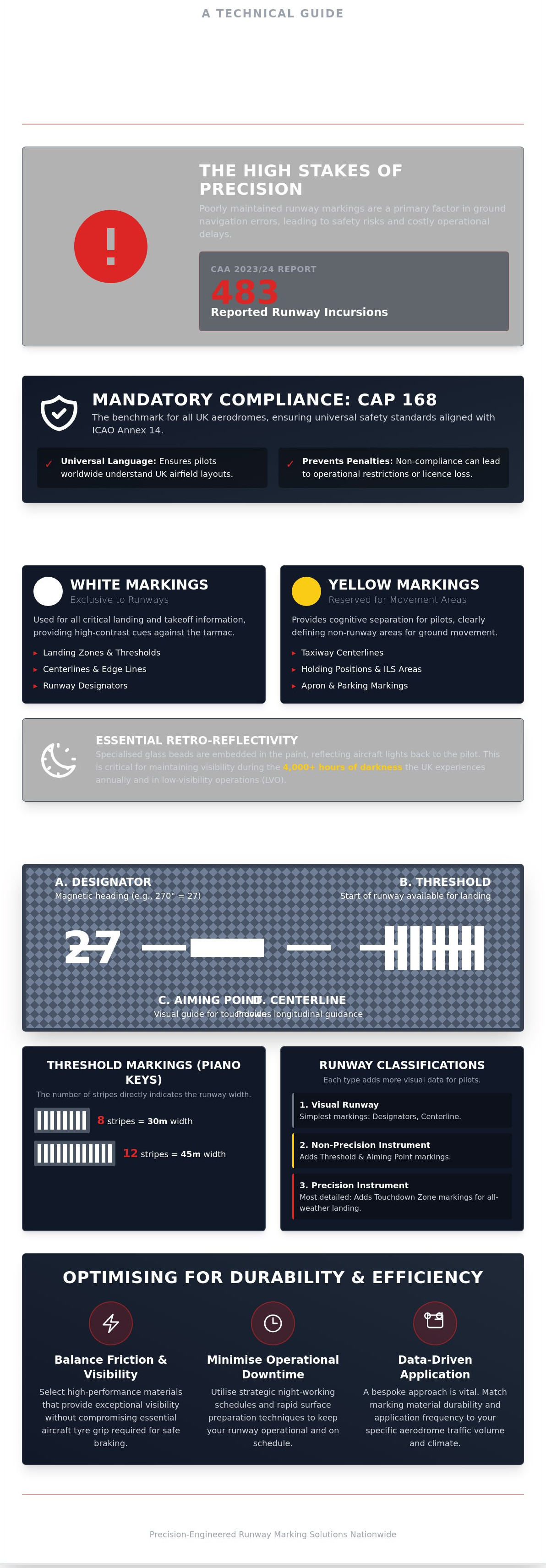
Safety isn’t an accident; it’s a result of high-contrast design and rigorous maintenance. The Civil Aviation Authority (CAA) reported 483 runway incursions in the 2023/24 reporting period. Crisp, well-maintained markings significantly reduce the risk of pilot confusion, ensuring every vehicle and aircraft stays exactly where it should. We view these markings as a bespoke safety layer that protects lives and prevents costly operational delays.
Whether you manage a major hub like Heathrow or a private grass strip in the Cotswolds, professional-grade application is vital. International airports require high-frequency maintenance to handle heavy tyre scrub, while private airfields need long-lasting solutions that remain visible through changing seasons. We move away from guesswork by using specialised materials that meet specific UK climatic demands. Our approach ensures that your airfield remains a reliable environment for all aviators.
Understanding CAP 168 Compliance
The Licensing of Aerodromes (CAP 168) sets the benchmark for every UK airfield. These rules ensure our domestic standards mirror the international ICAO Annex 14 guidelines, creating a universal language for pilots. Failing to meet these specifications can lead to immediate operational restrictions or the loss of an aerodrome licence. It’s a bespoke safety framework that demands precision in every stripe and number. We focus on transparency, ensuring every marking we apply is fully compliant with the latest 2026 safety updates.
Visibility and Human Factors
Human eyes process high-contrast colours fastest under stress. We use white for runway markings and yellow for taxiways to provide instant cognitive separation for the flight crew. During touchdown, these patterns provide essential cues for depth perception and closure rates. We prioritise retro-reflectivity by using specialised glass beads. This ensures visibility remains high during the 4,000+ hours of darkness the UK experiences annually, providing clarity when pilots need it most.
- White Markings: Used exclusively for runways to denote landing zones and centrelines.
- Yellow Markings: Reserved for taxiways, holding positions, and apron areas.
- Retro-reflectivity: Essential for low-visibility operations (LVO) and night flights.
Safety in aviation is multi-faceted, and the physical health of the team is just as important as the precision of the markings on the ground. For those in high-responsibility roles looking for professional support, medical weight loss UK offers a regulated, bespoke approach to managing wellness and physical fitness.
Decoding the Anatomy: Essential Runway Marking Types and Meanings
Precision starts with the paint. Runway markings aren’t just guides; they’re critical data points for pilots. Every symbol adheres to strict UK standards to ensure safety during high-stakes manoeuvres. Categorising these surfaces involves three main types: Visual, Non-Precision, and Precision Instrument runways. Each level adds a layer of visual data to assist the pilot’s decision-making process. Visual runways are the simplest, while Precision Instrument runways provide the most detailed cues for landing in poor weather.
The ‘Designator’ is the most recognisable element. These numbers represent magnetic headings rounded to the nearest 10 degrees. A runway facing 274 degrees becomes Runway 27. This system eliminates guesswork in the cockpit. If an airfield has parallel runways, ‘L’ and ‘R’ suffixes provide the necessary clarity for simultaneous operations. It’s a logical, data-driven approach to navigation that has remained the global standard for decades.
Threshold markings, often called ‘piano keys’, identify the start of the runway available for landing. The number of stripes is a direct indicator of runway width. A 30-metre runway requires 8 stripes, while a 45-metre surface needs 12. These markings are vital for calculating landing distance. They ensure the aircraft touches down with enough tarmac to stop safely. Touchdown zone and aiming point markings provide further depth perception. These white blocks start 150 metres from the threshold, offering a bespoke roadmap for the wheels to meet the ground.
Visual vs Precision Markings
Smaller, visual-only airfields use simplified runway markings. They usually only require designators and centre lines. In contrast, Precision Instrument runways demand a complex grid of touchdown zones. These markings support pilots when visibility is low. Side stripe markings are essential in these environments, as they define the lateral limits of the usable pavement. This prevents pilots from straying onto shoulders that can’t support aircraft weight. You can find detailed descriptions of these patterns in Airport Marking Aids and Signs, which provides a global benchmark for these safety features.
Threshold Variations and Displaced Thresholds
Not every runway starts at the pavement’s edge. A displaced threshold, marked by white arrows pointing toward the landing line, indicates that landing must happen further down the track. You can still use the preceding area for take-offs or taxiing. Chevrons indicate blast pads or stop-ways. These areas protect against jet blast or provide emergency overrun space. They aren’t for normal aircraft use. Using bespoke marking strategies ensures these critical zones remain visible and compliant with 2026 safety audits. Clear reporting on paint degradation in these high-wear areas is the only way to maintain long-term operational transparency.
Choosing the Right Materials: Durability, Visibility, and Friction
Standard road paint fails almost immediately on an active airfield. It’s designed for cars at 30mph, not a Boeing 787 landing at 160mph. High-stress environments demand bespoke material selection to ensure runway markings remain visible and intact under extreme shear forces. We don’t guess which product works best; we use data-driven testing to match the material to the specific traffic volume of your runway. This ensures you aren’t overspending on materials where they aren’t needed, or under-speccing in critical zones.
The “Friction Gap” is a critical safety metric that every airport manager must track. Thick paint layers can become slick when wet, leading to dangerous aircraft skidding. CAP 168 standards require markings to maintain a friction level within 0.15 of the surrounding pavement. Balancing this requirement with the need for long-term durability is where generic contractors often fail. We focus on thin-layer, high-friction applications that prioritise pilot safety over simple aesthetics. Retro-reflectivity is equally vital, achieved through the precise application of glass beads. These beads must meet BS EN 1423 standards to ensure they provide the necessary “bounce back” of light during night-time operations and low-visibility conditions.
High-Performance Materials for 2026
Thermoplastic remains a solid choice for taxiways because it’s fast-drying and cost-effective for large areas. However, for high-impact touchdown zones, MMA (Methyl Methacrylate) is the 2026 industry standard. It’s a cold-applied plastic that bonds chemically with the surface, offering a service life that often triples that of standard water-based options. We frequently integrate anti-skid aggregates directly into the mix to ensure the runway markings provide maximum grip even during a heavy British downpour.
- MMA: Exceptional durability for 24/7 operations in touchdown zones.
- Water-based paints: Ideal for temporary markings or airfields with lower traffic frequency.
- Thermoplastic: High-build performance suited for taxiway centerlines and apron boundaries.
Environmental and Atmospheric Considerations
British weather is notoriously unpredictable. Curing times for airfield materials must account for high humidity and the sudden temperature drops common in the UK. We select UV-resistant pigments to prevent the “grey-out” effect caused by constant sun exposure, ensuring markings stay bright for years. Resistance to aviation fluids is also vital. Our tailored solutions withstand constant contact with Skydrol hydraulic fluid and acetate-based de-icers, which would dissolve standard commercial paints in weeks. This proactive approach saves you money by extending the maintenance cycle and reducing operational downtime.
Planning and Implementation: Minimising Operational Downtime
Precision timing defines airfield maintenance. At major UK hubs like Heathrow or Manchester, a runway closure isn’t just a delay; it’s a financial drain. We execute runway markings during strict night-working windows, typically between 23:00 and 05:00, to keep traffic flowing. This requires a bespoke approach where every second is accounted for through data-driven scheduling. Our teams operate in high-intensity bursts, ensuring the runway is operational before the first morning flight departs at 06:00.
Surface preparation is the hidden key to longevity. If the substrate isn’t pristine, adhesion fails. We use precision-engineered machinery designed for airfield scales, ensuring consistent application across thousands of square metres. Removing old lines is vital. Ghosting occurs when old patterns remain visible, potentially confusing pilots during low-visibility landings. This phenomenon is a primary concern for the Civil Aviation Authority (CAA), as it can lead to runway incursions during heavy rain or night operations.
Advanced Line Removal Methods
Old markings don’t just disappear. Hydro-blasting uses water at pressures reaching 40,000 psi to strip paint without scarring the underlying asphalt. This method is preferred for its speed and lack of dust, which is critical for engine safety. For thicker, layered build-ups, mechanical scabbling provides the necessary physical force. Both methods prioritise the elimination of Foreign Object Debris (FOD). Even a single loose flake of paint or a stray pebble can cause catastrophic engine damage, making a clean surface a non-negotiable safety standard.
Project Management and Phasing
Success relies on seamless coordination with Air Traffic Control (ATC). We phase projects into manageable blocks, allowing for an immediate return to service using fast-cure materials like Methyl Methacrylate (MMA). These resins set in under 20 minutes, even in the unpredictable UK climate. Quality control is data-driven. We perform post-application tests for friction levels and retro-reflectivity, ensuring every marking complies with CAP 168 standards for the 2026 season. This transparency gives aerodrome managers total confidence in the results.
Markex: Precision-Engineered Runway Marking Solutions Nationwide
Markex brings over 40 years of experience to the UK’s most critical infrastructure projects. We’ve spent decades refining our processes on high-stakes airfields where precision isn’t just a goal, it’s a safety mandate. We don’t believe in a one-size-fits-all approach to aviation safety. Every aerodrome has its own pulse, and we tailor our material selection to your specific traffic volume and aircraft weight loads. This bespoke strategy ensures that your runway markings remain visible and effective long after the initial application.
We mobilise specialised teams across the United Kingdom to handle projects of any scale. From major international hubs to private regional strips, our national coverage means we’re ready to deploy whenever you need us. We prioritise transparency through every stage of the project. You’ll receive clear, data-driven reporting on material performance and regulatory compliance. We reject guesswork. Our evidence-based approach gives you the certainty required to meet the evolving 2026 aviation standards with total confidence.
Why Aerodrome Managers Trust Markex
Operational pressure is a constant in the aviation industry. We understand that every minute of runway downtime carries a significant cost. That’s why we offer fixed-price contract certainty and a no-nonsense delivery model. You won’t find hidden fees or unexpected delays in our programme. We use state-of-the-art equipment designed for precision-engineered application, ensuring that every line and symbol meets exact specifications on the first pass.
Our collaborative partnership model sets us apart from distant service providers. We act as your strategic partner, working around your flight schedules to minimise disruption. This proactive approach allows us to deliver high-quality results while respecting the intense demands of your daily operations. We focus on building long-term trust through honest communication and measurable results.
Get Your Aerodrome Compliance Audit
Knowing the exact state of your current infrastructure is the first step toward long-term safety. Our compliance audit identifies areas of wear and potential non-conformity before they become safety hazards. We use digital assessment tools to provide a clear, data-backed roadmap for your maintenance needs. This allows you to allocate your budget effectively based on facts rather than intuition.
The Markex promise is built on three pillars: durability, compliance, and safe execution. We ensure your facility remains fully operational and compliant with the latest CAA requirements. Our team is ready to help you navigate the complexities of modern airfield maintenance with clarity and expertise. Contact Markex for a bespoke runway marking quote today and secure the future of your aerodrome’s safety standards.
Securing Your Aerodrome Operations for 2026
Maintaining compliant runway markings isn’t just a regulatory checkbox; it’s the backbone of UK aerodrome safety. By 2026, the demand for precision and durability in airfield infrastructure has reached new heights. You’ve seen how selecting high-friction materials and planning for minimal downtime can transform operational efficiency across your site. It’s about finding the balance between high-visibility performance and long-term reliability without compromising on safety standards.
Markex brings over 40 years of industry experience to every project. We use specialised airfield-grade machinery to ensure every line meets stringent UK requirements. Whether you’re managing a major international hub or a regional strip, our nationwide UK service coverage means expert support is always available. We don’t believe in guesswork. We provide bespoke, data-driven solutions that keep your runways clear and your pilots informed. Our team focuses on results that matter to your safety record and your bottom line. To ensure the same level of quality for your VIP arrivals and ground transport, discover Onyx Rental for premium chauffeur services nationwide.
Ready to elevate your airfield standards? Request a Professional Runway Marking Consultation today and let’s get your project moving. Your success is our priority, and we’re excited to help you build a safer, more efficient future.
Frequently Asked Questions
What is the standard colour for runway markings in the UK?
White is the mandatory colour for all runway markings in the UK. This standard follows ICAO Annex 14 and CAA CAP 168 requirements to ensure maximum contrast against dark asphalt surfaces. While runways exclusively use white, yellow is reserved for taxiways and apron areas. This clear colour coding prevents pilot confusion during taxiing and low-visibility operations.
How often should runway markings be repainted or maintained?
Most airfields repaint runway markings every 6 to 12 months to maintain rigorous safety standards. High-traffic hubs like Gatwick require more frequent maintenance than smaller regional strips. You’ll need to conduct weekly visual inspections and formal friction testing every 6 months. This data-driven approach ensures your site remains compliant with CAA safety regulations year-round.
What is the difference between a visual and a precision runway marking?
Visual runway markings include only the basic designators and centrelines for pilots landing by sight in clear weather. In contrast, precision markings add aiming points, touchdown zones, and side stripes to support Instrument Landing System (ILS) approaches. These extra indicators are vital for safe landings when visibility drops below 800 metres, providing the clarity pilots need during complex arrivals.
Can standard road marking paint be used on an aircraft runway?
You can’t use standard road paint on an aircraft runway because it doesn’t have the necessary chemical resistance or durability. Runway markings require specialist paints, such as waterborne acrylics or methyl methacrylate (MMA), that meet BS EN 1871 standards. These bespoke coatings are designed to withstand intense heat from jet blasts and resist degradation from spilled aviation fuel.
How do displaced threshold markings affect landing and take-off distances?
A displaced threshold reduces the Landing Distance Available (LDA) but typically leaves the Take-Off Run Available (TORA) unaffected. This marking shows that the landing area starts further down the strip, usually to clear obstacles like trees or perimeter fences. It’s a strategic solution that ensures aircraft maintain a safe 5% glide slope during their final approach to the airfield.
What is CAP 168 and how does it affect my airfield markings?
CAP 168 is the Civil Aviation Authority’s primary regulatory document for aerodrome licensing and safety standards. It dictates the exact dimensions, spacing, and colours required for every marking on your airfield. Following these rules is mandatory for any UK site handling commercial flights. We use these guidelines to build a bespoke maintenance plan that guarantees your site passes every inspection.
How does hydro-blasting help with runway marking removal?
Hydro-blasting uses ultra-high-pressure water at 40,000 psi to strip old paint without damaging the underlying pavement. This method is 95% more effective than traditional grinding and leaves a clean, porous surface that’s ready for immediate repainting. It’s the industry standard for maintaining surface integrity and ensures your new markings bond perfectly to the asphalt or concrete.
What are the friction requirements for markings on a runway surface?
Runway markings must maintain a friction level within 0.25 of the surrounding surface to prevent aircraft skidding. CAP 168 specifies that you must add glass beads or anti-skid aggregates to the paint to achieve this. Regular testing ensures that markings don’t become dangerously slippery when wet. This is especially important in the touchdown zone where tyres first make contact with the surface.