
Warehouse Safety Barriers: The Strategic Guide to UK Compliance and Protection
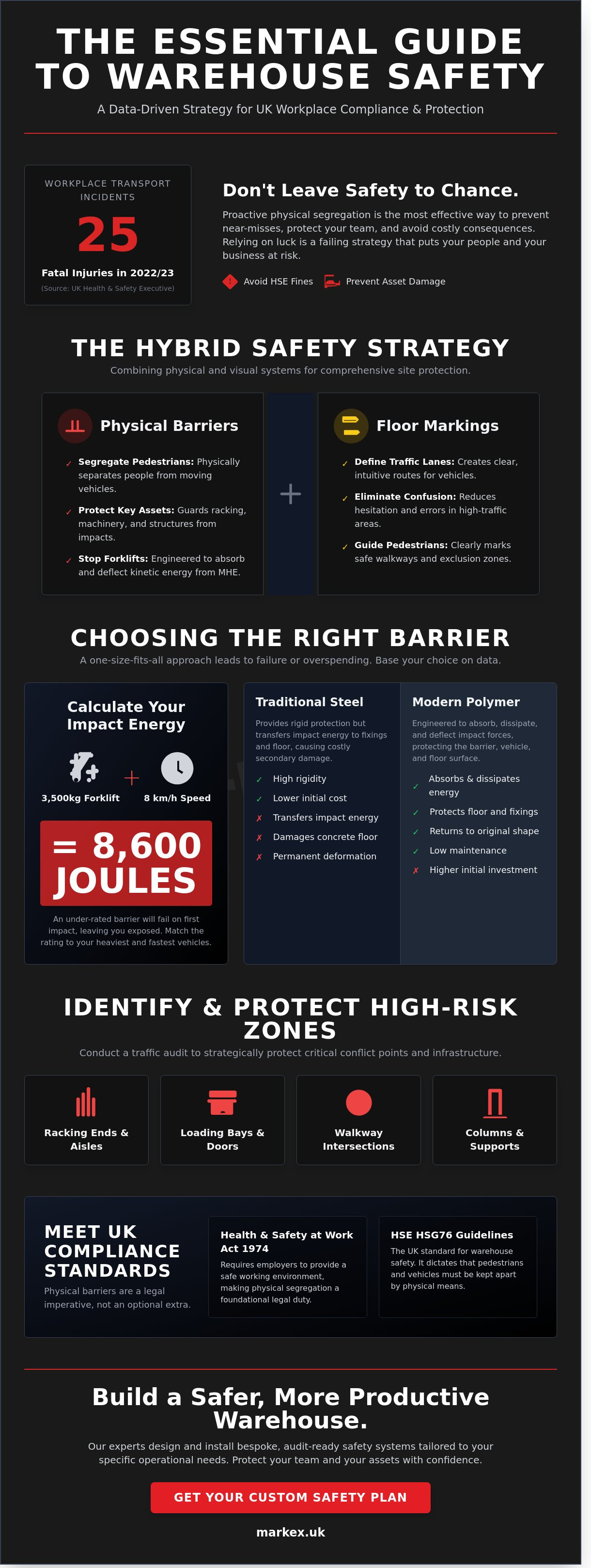
Did you know that workplace transport incidents remain one of the leading causes of fatal injuries in UK industry, with the HSE reporting 25 deaths in the 2022/23 period alone? It’s a sobering reality that keeps facility managers awake at night. You likely feel the pressure to eliminate risks using robust warehouse safety barriers while maintaining a high-speed operational flow. Balancing rigorous compliance with daily productivity is a challenge, especially when you’re faced with complex impact ratings and the constant threat of costly HSE fines.
We believe safety should empower your growth, not restrict it. In this guide, you’ll discover how to integrate high-performance physical protection and floor markings into a bespoke, audit-ready system. We move past the guesswork to provide data-backed strategies for pedestrian segregation and asset protection. You will learn how to select durable materials that safeguard your expensive racking and machinery while ensuring your facility passes every safety inspection with total confidence.
Key Takeaways
- Master UK compliance standards to protect your team and meet legal obligations under the Health and Safety at Work Act 1974.
- Discover how to select the right warehouse safety barriers by calculating precise impact ratings, ensuring you never overspend on unnecessary specifications.
- Learn why a hybrid strategy of physical barriers and visual floor markings is essential for eliminating dangerous blind spots and traffic confusion.
- Identify high-risk conflict points through a strategic traffic audit to protect critical structural elements like mezzanine supports and building columns.
- Understand the vital role of floor surface quality in barrier stability to ensure your precision-engineered safety system remains robust and reliable.
The Role of Warehouse Safety Barriers in UK Workplace Compliance
Safety isn’t a checkbox; it’s the foundation of every high-performing industrial site. Effective warehouse safety barriers act as critical infrastructure that mitigates risk before an accident occurs. These systems provide a physical layer of protection that separates human workers from heavy machinery. Without them, you’re relying on luck rather than a data-driven safety strategy.
Legal compliance starts with the Health and Safety at Work Act 1974. This legislation requires employers to provide a safe environment, making physical barriers a legal imperative rather than an optional extra. If a site lacks proper segregation, the Health and Safety Executive (HSE) can issue improvement notices or heavy fines. We help you avoid these pitfalls by implementing bespoke protection plans that meet every statutory requirement.
Proactive physical segregation is the most effective way to reduce “near-miss” incidents. These are the warnings you get before a serious injury happens. By using a Safety barrier to define clear traffic lanes, you remove the guesswork from warehouse navigation. It’s about creating a transparent environment where every driver and pedestrian knows exactly where they belong—a goal further supported by ensuring staff are clearly identifiable through professional, custom-printed clothing from RAW Merch.
Beyond safety wear, if your organization requires high-quality leather accessories for staff or corporate gifting, check out Primehide Trade for premium wholesale options.
Similarly, for those looking to furnish warehouse administrative offices or breakrooms with durable, high-quality pieces, you can explore Solid Oak Dining Table options and other handcrafted furniture from Masterplank UK.
Additionally, for companies in the health and dry food sectors looking to streamline their distribution, Simplepack Ltd provides professional contract packing solutions designed to meet high industry standards.
Furthermore, if your facility upgrade extends to administrative areas, Excel Business Environments Ltd provides turnkey office fit-outs and commercial refurbishments that integrate seamlessly with your industrial operations.
The financial case for these installations is just as strong as the safety case. Replacing a single damaged pallet racking upright can cost hundreds of pounds in parts and labor, not to mention the lost productivity during repairs. Protecting your racking and Material Handling Equipment (MHE) with heavy-duty barriers prevents this unnecessary drain on your budget. It’s a straightforward investment that protects your bottom line while you’re scaling your operations.
Understanding HSE HSG76 Guidelines
HSG76 is the primary UK standard for warehouse safety and traffic management. This guidance dictates that pedestrians and vehicles should be kept apart through physical means whenever possible. The HSE views the hierarchy of control as a roadmap; physical segregation is always preferred over mere signage or floor markings. By following these guidelines, you move away from guesswork and toward a proven framework for workplace transport safety.
Protection of Personnel vs. Asset Protection
It’s vital to differentiate between pedestrian handrails and heavy-duty impact barriers. Handrails are designed to guide people and prevent falls, while impact barriers are engineered to stop a 5-tonne forklift in its tracks. High-risk zones, such as rack ends and loading bays, require physical protection that is non-negotiable. We balance these safety requirements with your need for operational throughput. A well-designed layout keeps your team safe without slowing down the pace of your business.
Choosing the Right Barrier Specification: Impact Ratings and Materials
A one-size-fits-all approach to warehouse safety barriers is a recipe for wasted capital. Buying a barrier without analyzing your specific traffic profile leads to two outcomes: premature equipment failure or massive overspending on unnecessary specs. You need a solution tailored to your operational reality. A 2.5-tonne electric pallet jack requires a completely different level of protection than a 7-tonne counterbalance forklift operating in a high-speed loading bay.
The science of impact energy dictates your requirements. A 3,500kg forklift moving at a modest 8km/h generates approximately 8,600 Joules of energy upon impact. If your installed barriers are only rated for 5,000 Joules, they act as little more than decorative fencing. While high-quality perimeter solutions from Romford Fencing Ltd are ideal for site security, internal high-impact zones require specifically engineered systems. Cheap, non-certified systems often reach their “critical fail point” during the first minor bump because they lack dynamic test data. These systems may look sturdy, but they often snap at the base plate, leaving your staff and infrastructure vulnerable.
Floor conditions are the silent partner in barrier performance. A barrier is only as effective as its anchor. High-strength systems require specific concrete PSI levels and bolt depths to function as intended. Following official HSE guidance on warehouse safety ensures your layout maintains the legal separation between pedestrians and moving plant machinery while accounting for these structural variables.
Steel vs. Polymer Barriers: Which is Best for Your Facility?
Steel is the traditional industry standard. It provides rigid protection and a lower initial purchase price. However, steel doesn’t absorb energy; it transfers it. When a forklift hits a steel rail, that energy travels directly into the floor bolts, often shattering the concrete slab. Polymer barriers utilize “memory” properties to flex on impact and return to their original shape. While polymer systems often carry a 25% higher upfront cost, data-driven ROI models show they pay for themselves within 24 months by eliminating floor repairs and the need for constant repainting.
Impact Ratings and Load Capacities Explained
Understanding Joules is vital for selecting the correct warehouse safety barriers for your site. You must match the barrier height and strength to your specific vehicle types. A reach truck has different impact points than a heavy-duty side loader. You also need to account for “deflection space” behind the rail. Every barrier moves when struck. If you place a flexible polymer rail only 5cm away from an expensive control panel, the barrier might survive the hit, but the deflection will still crush your equipment. A bespoke site audit provides the clarity needed to avoid these costly spacing errors.
The Hybrid Safety Strategy: Integrating Barriers with Floor Markings
Physical barriers provide the muscle, but floor markings provide the brain. Relying solely on warehouse safety barriers often creates a false sense of security. Without clear visual cues, MHE operators frequently misjudge distances, leading to a 15% increase in “near-miss” collisions in zones lacking floor definition. We take an “Expert Friend” approach to your layout. This means using site data to map out the most efficient traffic routes before a single bolt is tightened.
By applying uk road markings principles to your internal navigation, you create a familiar environment for drivers. Consistency is the goal. When the rules of the yard match the rules of the warehouse, human error drops significantly. This total segregation strategy ensures that even a visitor on their first day can navigate the floor without hesitation.
Creating Visual and Physical Segregation Zones
High-visibility floor lines act as a pre-warning system. We recommend installing a 1.2 metre “safe zone” of yellow hatching before a pedestrian even reaches a physical barrier. This buffer gives forklift drivers a clear visual indicator of pedestrian proximity. Colour coding must be absolute to be effective:
- Green: Dedicated pedestrian walkways and safe assembly points.
- Yellow/Black: General hazard zones and MHE thoroughfares.
- Red: Strict no-go areas, such as charging stations or high-voltage zones.
Maintaining this logic between your external yard markings and internal warehouse safety barriers prevents the “transition shock” that causes 22% of site accidents during shift changes.
Enhancing Visibility with High-Contrast Markings
Strategic Layout Planning: Where to Install Safety Barriers
Effective safety doesn’t happen by accident. It starts with a data-driven traffic audit. You need to map exactly where Material Handling Equipment (MHE) and pedestrians overlap to identify high-risk conflict points. In 2023, the Health and Safety Executive (HSE) reported that vehicle-related incidents accounted for 20% of all workplace fatalities. This makes separating people from machines your first priority.
Don’t ignore the structural bones of your building. Mezzanine supports and building columns are critical points that require dedicated shielding. A single forklift collision with a load-bearing column can compromise the entire facility’s integrity. To ensure all aspects of your building’s structure are secure—from internal columns to external features—Powerpillar Ltd provides professional insights on essential elements like parapets. We recommend installing high-visibility warehouse safety barriers around every structural support located within 2 metres of a high-traffic lane.
Corners are notorious high-risk zones. You should manage these blind spots with a combination of physical barriers and convex mirrors. This dual approach ensures drivers see oncoming foot traffic while physical guards provide a “last line” of defense if a maneuver goes wrong. Safety is about layers, and physical protection is the final, most important layer.
Compliance also means ensuring movement during an emergency. Safety barriers must never obstruct fire exits or access to emergency equipment. Maintain a 1.2-metre clearance zone around all fire extinguishers and alarm points. This ensures your protection measures don’t become hazards during a crisis.
Critical Protection Points: Racking and Pedestrian Crossings
Racking end-protectors are non-negotiable. The first and last uprights in a row sustain 80% of all accidental warehouse impacts. Installing heavy-duty protectors here prevents rack collapse and stock damage. For long barrier runs, you must design safe “break-through” points every 15 to 20 metres. Integrate these with self-closing gates to create active safety zones. These gates force a conscious pause, ensuring pedestrians check for traffic before stepping into a vehicle lane.
Managing Traffic Flow and MHE Zones
Creating dedicated charging zones for electric forklifts requires specialized impact protection. Use warehouse safety barriers to shield battery units from moving vehicles during swap-outs. You can use low-level barriers to prevent pallet encroachment into walkways, keeping paths clear for staff. Finally, place strategic bollards at loading bay doors. These high-frequency entry points are prone to “clip” accidents; a 1.2-metre steel bollard offers the durability needed to withstand repeated low-speed impacts without failing.
Build a safer workspace with a bespoke barrier layout strategy today.
Professional Installation and Maintenance: The Markex Approach
Stability starts from the ground up. The quality of your floor surface is the primary factor determining whether your warehouse safety barriers actually perform during a collision. Industry data suggests that 15% of safety system failures occur not because the steel failed, but because the floor slab could not hold the anchor under pressure. Markex takes a no-nonsense approach to precision-engineered safety. We don’t just sell hardware; we deliver integrated protection systems that respect the structural integrity of your facility. Our team focuses on the technical variables that DIY installations often overlook.
Professional core-drilling and deep anchoring outperform standard DIY bolt-downs every time. While a basic bolt might look secure to the naked eye, it often lacks the tensile strength to withstand a 5,000kg forklift impact. Our installers use industrial-grade equipment to ensure every fixing reaches the optimal depth for your specific concrete grade. This precision prevents the “lever effect” that rips chunks out of your floor during an accident. To keep your site compliant with UK health and safety standards, we develop a bespoke maintenance schedule. This proactive strategy ensures your protection remains robust for years, rather than just months.
Why Bespoke Safety Solutions Outperform DIY Kits
Guesswork is the enemy of site safety. Off-the-shelf kits ignore the unique variables of your facility, such as high-traffic pinch points or the specific 200mm depth of your floor slab. Expert planning prevents future accidents by aligning barrier height and impact resistance with your actual risk profile. We don’t believe in one-size-fits-all. Markex integrates commercial safety markings with physical hardware to create a turnkey solution. This dual-layered approach uses visual cues to manage driver behavior while the warehouse safety barriers provide the final line of physical defense.
While industrial settings require this level of specialized engineering, those performing general home maintenance or garden improvements can find a reliable selection of DIY tools and products at Klevaro, and can learn more about The BBQ Experts for premium outdoor cooking equipment.
Long-Term Durability and Surface Preparation
Success depends on the preparation phase. We utilize professional line removal and surface grinding to create a clean, level installation area. This ensures the base plates sit flush against the slab, which eliminates vibration and premature wear. Using high-grade anchors is a non-negotiable necessity to prevent floor cracking and structural splintering during a high-energy impact. For facility managers who need specialist bonding agents or industrial sealants to support these structural repairs, check out Bondrite Adhesives Ltd. We focus on these technical details so you can focus on scaling your operations without the fear of compliance failures. If you’re ready to secure your facility with data-backed precision, request a bespoke safety audit and quote for your national warehouse project today.
Future-Proof Your Facility with Strategic Protection
Compliance isn’t a box-ticking exercise; it’s a data-driven strategy for operational growth. You’ve seen how the right warehouse safety barriers, when combined with HSE-compliant layouts and high-visibility floor markings, transform a high-risk environment into a streamlined workspace. Protecting your team requires more than just hardware. It demands a hybrid approach that considers impact ratings and strategic traffic flow to prevent accidents before they happen. Markex brings 40 years of specialist contracting experience to your project, ensuring every installation meets the rigorous standards required for large-scale industrial sites across the UK.
We provide national coverage and bespoke safety planning that removes the uncertainty from workplace protection. Our team focuses on transparent communication and measurable results, helping you scale your operations with confidence. Get a bespoke quote for your warehouse safety project from Markex and secure your facility today. It’s time to build a safer, more efficient future for your business.
Frequently Asked Questions
What are the HSE requirements for warehouse safety barriers?
The Health and Safety Executive (HSE) mandates clear segregation between pedestrians and vehicles under the HSG76 guidance. It’s essential to install physical warehouse safety barriers in areas where the risk of collision is high. These systems must be capable of stopping a vehicle under normal operating conditions to comply with the Workplace (Health, Safety and Welfare) Regulations 1992.
How do I choose between steel and polymer safety barriers?
Choose steel for rigid, permanent protection and polymer for areas where high-frequency, low-speed impacts occur. Steel provides a solid block for heavy machinery, but polymer barriers absorb 80% of impact energy and return to their original shape. This flexibility prevents floor damage and reduces the need for constant repairs after minor forklift bumps.
What is the standard height for a warehouse pedestrian barrier?
The standard height for a pedestrian barrier is 1100mm. This measurement aligns with BS EN ISO 14122-3 safety standards to ensure the rail is high enough to prevent falls and provide a clear visual boundary. At this height, the barrier remains visible to forklift operators even when they’re carrying bulky loads that might obscure lower markings.
How much impact can a standard warehouse barrier withstand?
A standard industrial barrier typically withstands impacts ranging from 5,000 to 20,000 Joules. For perspective, a 5-tonne forklift moving at 3mph generates roughly 4,500 Joules of kinetic energy. We use data-driven calculations to match barrier strength with your specific vehicle weights and speed limits to ensure your warehouse safety barriers actually perform when hit.
Do I need barriers if I already have floor markings in my warehouse?
Yes, because floor markings offer zero physical protection against a 5-tonne vehicle. While markings help with navigation, HSE data shows that 25% of workplace transport accidents involve pedestrians. Physical barriers provide a fail-safe zone that stops a vehicle incursion, whereas a painted line relies entirely on the driver’s constant attention and perfect braking.
How often should warehouse safety barriers be inspected for damage?
Perform visual checks daily and schedule a formal, documented inspection every 6 to 12 months. SEMA guidelines suggest that any safety equipment protecting pallet racking should follow a strict inspection rhythm. If a barrier sustains a hit that deforms the material or loosens the floor anchors, you must replace or repair it immediately to maintain site integrity.
Can safety barriers be installed on any type of warehouse floor?
Safety barriers require a reinforced concrete base with a minimum thickness of 150mm for secure anchoring. Installing heavy-duty protection on asphalt or thin screed is dangerous because the floor will crack under impact. We provide bespoke advice on floor suitability to ensure your anchors don’t pull out during a collision, which would render the barrier useless.
What is the best way to protect pallet racking from forklift damage?
The most effective strategy involves installing 400mm high end-of-aisle protectors and individual upright guards. These components follow the SEMA Code of Practice and act as the first line of defense for your storage systems. By shielding the most vulnerable parts of the rack, you prevent structural collapses that often stem from repetitive, minor forklift impacts at the aisle entry points.